Jordan 1 Lost and Found Real vs Fake: Chicago 2022 Guide

Última actualización:
To tell a Jordan 1 Lost and Found real vs fake, check the heel shape from behind, the Swoosh and its stitching, the cracked leather, the Wings logo, the tongue and its label, the toe box, the outsole, the insole and finally the size tag and box. The shoe is aged on purpose, so a worn look, a cracked collar and a beaten-up box are normal on a genuine new pair. Judge the shape and the details, not the wear.
The Air Jordan 1 High OG "Chicago Lost and Found", also sold as "Reimagined", is style code DZ5485-612. It released on 19 November 2022 at $180, in family sizes. Nike's story for the release is that pairs of the 1985 Chicago were left in the stockroom of an old sneaker shop and found decades later, which is why the upper, tongue, sole and box all look old.
Table of Contents
[ open ]Lost and Found or Another Chicago?
The red, white and black Chicago colorway has been released several times. The Lost and Found (DZ5485-612) is the one with a cream midsole, cracked-look leather, a yellowed tongue and a deliberately worn box. The 2015 Chicago retro has clean, bright materials and is covered in our Jordan 1 Chicago guide. Read the style code on the size tag first, so you compare your pair with the right release.
What the Aged Look Means for Authentication
Most fake checks treat wear as a warning sign. On this shoe, Nike built the wear in:
- a black collar with faux cracking, and faux cracking on the toe and the mid-panel
- a pre-yellowed nylon tongue
- an aged, cream-colored sole
- a box made to look old, with bent edges, a scuffed top and an orange lid that does not match the base
- a mock handwritten receipt from a made-up shop.
The ageing also differs from pair to pair, so two genuine pairs will not look the same. Never call a pair fake because it looks more or less worn than another. Use the checks below, which look at shape, stitching and print. For the checks every Jordan 1 shares, see our guide to spotting fake Jordan 1s.
Hourglass Shape

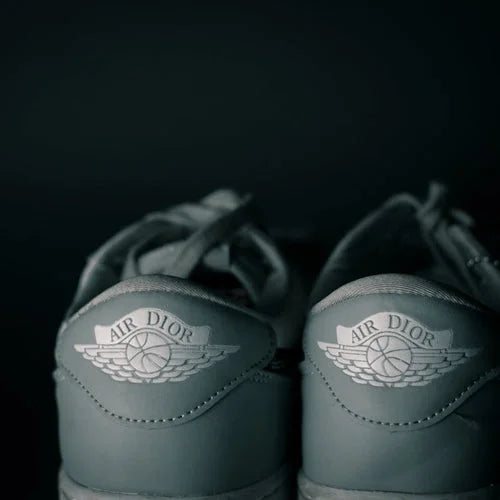
Look at the shoe from behind, unworn and without a foot inside. Most retail Jordan 1 Highs narrow slightly in the middle, where the seam is, and widen again above and below, the shape often called the hourglass. The fake we compared had a much straighter heel with little curve. The depth of the hourglass varies by release and factory, and some genuine pairs are closer to a straight funnel, so compare only with a genuine Lost and Found in the same size. The photo above is cropped to the top of the heel, so it does not show the overall shape.
In the close-ups, also compare the stitching on the heel tab and along the black collar line. It should be even and follow the edge of each panel closely.
Authenticators also compare the curve at the very back of the heel on Chicago-family Jordan 1s: it is usually soft and natural on genuine pairs, while many fakes look swollen and bulging there.
Swoosh

Start with the Swoosh's shape. It should come to a sharp point near the laces and be thick through the middle. Then follow its stitching. On the genuine pair the stitches are even and close to the edge, and the leather is cut cleanly. Uneven or wandering stitches and rough edges are reasons to look more closely.
The close-ups below the main photo show the stitching near the Swoosh tip on both pairs. Compare the spacing of the stitches and how close they sit to the edge.
Cracked Leather
The faux cracking on the collar, toe and mid-panel is the shoe's main design feature. Because it is different on every pair, how heavy it is proves nothing. A lightly cracked genuine pair is still genuine. The aged look alone cannot decide whether a pair is real.
Look inside the cracks instead. On the genuine pair in our comparison, the cracking has an irregular pattern. On the fake used for this guide, the grain of the leather was larger. The Jordan 1 Spiderman guide is another Chicago-based Jordan 1 where leather texture matters.
What an authenticator compares is how the cracking was made. On genuine pairs the cracks usually run deep across the toe, the white panels and the heel, while fakes often show thinner cracks or a printed texture that looks laminated on top of the leather. Genuine pairs vary, so judge the kind of cracking, not how much of it there is.
Wings Logo
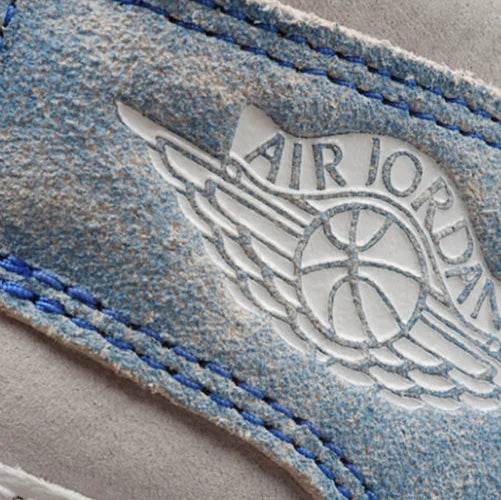
The Wings logo is stamped into the black leather of the collar. Judge it by its shape and the crispness of the stamp, not by its depth alone.
Lettering
Check the size and spacing of the "AIR JORDAN" letters. On the genuine logo they are fine and evenly spaced. On the fake we compared, the letters are thicker and their alignment is slightly off.
Wings
The feathers of the wings should have clear, even gaps between them. On the fake they sit too close together, and the stamp loses detail in close-up photos.
The Tongue
The Lost and Found has a pre-yellowed nylon tongue, so a yellow tongue on a new pair is normal. Compare its shape instead. On the fake we compared, the tongue is longer and the stitching on it sits higher than on the genuine pair.
If the pair has a Nike Air tongue label, one of the things an authenticator compares is the ® after NIKE AIR. On fake Jordan 1 Highs, the R often touches the circle around it or ends in small hooks, while the genuine R stands clear. Compare it only with a genuine label from the same release.
Interior Tongue Label
The tongue label is red with white lettering. The real and fake labels look almost the same at first, but the fake's letters are thicker and clumsier. Look at the letter "O" in particular: on the genuine label it is rounder.
Toe Box
Shape
Look at the toe box from the side. On the genuine pair it sits higher and looks fuller. On the fake it is flatter, without the same curve. Authenticators also check the slope of the line across the toe on this release.
Perforations
The toe box has rows of small perforations. On the genuine pair they are small and evenly punched. The fake we compared copies the pattern, but its holes are visibly larger.
Outsole

The outsole is aged on purpose too, so do not judge it by its shade or by marks on the rubber. Look at how the pattern is molded. On the genuine pair the circles of the pivot point, the lines and the Nike logo have precise edges. On the fake the edges are softer and the details less defined.
Insole
Take out the insole and look at its surface. The genuine insole is usually fine and smooth, with even vent holes. On the fake we compared, the surface has a coarser, more pronounced texture. Check the print on the insole as well: clumsy letters and poor printing point to a fake.
Size Tag
The size tag sewn inside the tongue or collar is the busiest label on a pair of Jordans. It shows the size in several systems, the country of manufacture, the style code, a UPC barcode, a short factory code and two dates. Nike has never said what the two dates mean. They are often read as the production window, but that is not confirmed, so treat them only as a rough check that they suit the release. Tags printed from around 2019 often add a QR code, and many genuine older tags have a barcode only. Counterfeiters copy genuine tags field by field, so a tag that agrees with itself shows the label is consistent, not that the shoes are real.
What to check on a Lost and Found tag
The tag should read DZ5485-612, and its dates should be plausible for a November 2022 release. Fakes print the same style code, so the number alone tells you little. Compare the font, size, placement and print quality of the tag with a confirmed genuine Lost and Found tag.
QR Code
The QR code on a recent Jordan size tag opens an address on qr.nike.com followed by a 13-character code, and the same code is printed beside the QR. It opens a Nike page, not an authenticity check. In our November 2026 test, qr.nike.com logged each scan and sent every well-formed 13-character code, even ones we made up, to the same Nike page. Malformed codes went to the Nike home page. So a scan proves nothing either way, and fakes print working codes too. A QR that opens a site other than nike.com is a strong reason to get the pair checked, and many genuine older pairs have no QR at all. See what a Nike QR code and UPC can show.
A fake tag can print a QR in the same qr.nike.com format as a genuine one.
Dates are a useful question on this pair. Tag dates that fall after the November 2022 release are one of the things an authenticator questions.
Code checks that can expose a fake Lost and Found
No code can prove a pair is real, but these checks can expose a fake label:
- The barcode belongs to DZ5485-612. The 14-digit number after "UPC" on the tag is Nike's barcode for one style code in one size. A fake label can carry a real Nike barcode that belongs to another colorway or size, and it still scans. An authenticator checks that the barcode is Nike's number for DZ5485-612 in the size printed beside it.
- The tag and the box agree. The box label prints the same barcode with one leading zero instead of two, plus a small two-digit add-on. Ignore the zeros and the add-on, and the digits should match the tag. A mismatch is a question for the seller, not proof, because genuine pairs end up in other boxes.
- The QR code uses Nike's alphabet. The 13 characters printed beside the QR use the digits 0 to 9 and every letter except I, L, O and U. Nike's own QR server rejects any code that contains one of those four letters, and a fake tag can print them. A well-formed code proves nothing, because qr.nike.com sends every well-formed code, even an invented one, to the same Nike page and shows no result.
- The dates fit the release. On the genuine Jordan tags we have read, both dates fell before the release, the later one by two to five months. A first date after the November 2022 release is a reason to ask whether the pair is a restock, not proof of a fake. Some fakes copy genuine dates exactly, so plausible dates prove nothing either.
- The patent line is spelled right. Recent Nike tags end with "This product is covered by one or more patents: www.nike.com/patentsvirtualmarking". A misspelled line or a different address is one of the things an authenticator compares. Older tags may not carry the line at all.
You can type the style code, the barcode and the QR code into our free Nike and Jordan code checker to run the format and match checks, and our guide to what a Nike QR code and UPC can show explains each code in full.
Box and Box Label
The label on the end of a Jordan box repeats the shoe's details: the model name, the style code, the size, the colorway and a UPC barcode, and recent labels add a QR code. On a genuine pair in its own box, the UPC on the label matches the one on the size tag, while the box QR carries a different code from the tag QR. A second barcode sticker from a resale platform is normal, and so is a regional label on pairs sold in Asia. Box labels are the easiest part to reprint, so compare fonts and spacing only against a genuine box from the same release. A missing or replacement box is not a sign of a fake.
The genuine Lost and Found box is made to look old. It has bent edges, a scuffed and faded top, and an orange lid that does not match the base. A worn box and an odd lid are part of the design. On the genuine pair we decoded, the UPC on the box label matched the size tag.
The Mock Receipt
Every pair ships with a mock handwritten receipt from a made-up shop, Sandy Bros. Sports Depot, dated 1985. It is part of the packaging design, not a proof of purchase. Fakes copy it, and a genuine receipt can be put in a box with fake shoes, so a receipt proves nothing on its own. A pair without one can still be genuine.
A real proof of purchase is the order confirmation from the shop that sold the pair in 2022. Ask a private seller for it, but treat it as one piece of evidence, not a verdict.
Packaging details are where Lost and Found fakes improved fastest. Early fakes had oversized sale stickers on the box, a two-part receipt on whiter, thinner paper and the wrong spare laces, and a batch made a few months later had already fixed the stickers and the laces. Treat any packaging detail as a reason to look at the shoes, never as the answer.
Frequently Asked Questions
How can you tell if Jordan 1 Lost and Found are fake?
Check the hourglass heel, the Swoosh stitching, the Wings logo, the tongue label, the toe box and perforations, the outsole pattern and the insole against a genuine pair of DZ5485-612. Ignore how worn the pair looks, because the ageing is part of the design and varies.
What is the style code of the Jordan 1 Lost and Found?
DZ5485-612. The size tag and the box label should both carry it, and their UPCs should match on a pair in its own box.
Does the Lost and Found box come damaged?
It comes made to look old: bent, scuffed and faded, with an orange lid that does not match the base. That is by design, so a worn box is not a sign of a fake.
Is the Lost and Found the same as the Jordan 1 Chicago?
It is the same colorway, but a different release. The Lost and Found (2022) has an aged finish, a cream midsole and a yellowed tongue. The 2015 Chicago has clean materials. The Off-White Jordan 1 Chicago is a third, very different take on the colorway.
Does a receipt prove my pair is real?
No. The handwritten receipt in the box is a mock prop that fakes copy. Even an order confirmation only shows that a pair was bought, not that it is the pair in front of you.
See If Your Lost and Found Is Authentic
If you are still unsure after these checks, send clear photos of both shoes from the side and from behind, the Wings logo, the tongue label, the toe box, the outsoles, the insoles, the size tags and the box label. LegitGrails authenticates Jordan from photos you upload, with results in under 30 minutes and a digital certificate with every order.
If your Jordan 1 Lost and Found fails any of these steps, send photos to our Jordan authentication service.