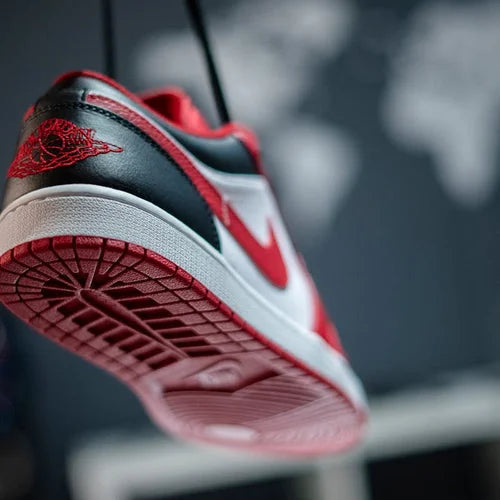
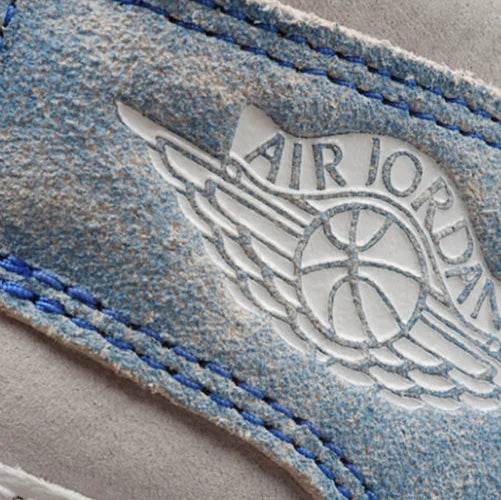
Jordan 1 Spiderman Real vs Fake: Next Chapter and Origin Story

Última actualización:
To tell a Jordan 1 Spiderman real vs fake, first work out which Spider-Man pair you have, then check the tongue label, the stitching, the Wings logo, the comic dot print, the heel shape, the outsole and finally the size tag and box label. Compare each detail with a confirmed genuine pair of the same release and size.
There are two Spider-Man Air Jordan 1 Highs on the market and a third is reported for 2027. They share the Chicago-style red, white and black blocking of the Jordan 1 Chicago, but their materials, outsoles and boxes are different, so a tell from one pair can mislead you on the other. The real and fake photos in this guide show the 2023 "Next Chapter" pair.
Table of Contents
[ open ]Which Spider-Man Jordan 1 Do You Have?
Read the style code on the size tag or the box label. It tells the pairs apart faster than any photo.
| Pair | Style code and release | How to recognise it |
|---|---|---|
| Origin Story (Into the Spider-Verse) | 555088-602, 14 December 2018, $160 at retail | Red overlays with reflective dots, glossy black collar accents and an icy translucent outsole |
| Next Chapter (Across the Spider-Verse) | DV1748-601, 20 May 2023, $200 at retail | Mixed leather and suede panels, a comic dot print on the eyestays and ankle flaps, a black patent collar and Swoosh, and a translucent outsole that glows in the dark |
| Beyond the Spider-Verse | JA1074-001, reported for 2027 | Not released yet. Treat any pair sold as this one before an official release date with caution |
Grade-school sizes have their own style codes (the Origin Story GS is 575441-602 and the Next Chapter GS is DV1753-601), so check a kids' pair against a kids' reference. The Origin Story and the Next Chapter are both tied to Sony Pictures Animation's Spider-Verse films and carry Marvel branding.
Side Profile and Swoosh

Start with the whole shoe from the side. On the Next Chapter, the Swoosh and the collar are black patent leather. In the comparison above, look at the shape of the Swoosh, especially the curve of its tip and where its tail meets the heel panel, and at the stitch line that runs around it. Compare these with a genuine pair of the same size, because panel proportions change slightly across the size run.
Ignore how glossy the patent looks in a photo. Light, camera and wear change the shine, so it tells you nothing about the pair.
A receipt or an order confirmation from a known retailer helps, but genuine receipts can be passed on with fake shoes, so use it alongside the checks below, never instead of them.
Tongue
The Next Chapter's tongue label is stitched onto a nylon tongue. Check the stitching that holds the label and the edges of the tongue: the stitches should be even in size and spacing, with no loose or doubled threads.
Do not judge the shade of the tongue. White nylon looks pink, yellow or grey depending on the light and the screen, and genuine pairs yellow with age.
If the pair has a Nike Air tongue label, one of the things an authenticator compares is the ® after NIKE AIR. On fake Jordan 1 Highs, the R often touches the circle around it or ends in small hooks, while the genuine R stands clear. Compare it only with a genuine label from the same release.
Tongue Label
The tongue label at the top of the tongue looks right on most fakes at first glance, so check it closely.
On the pair we compared, the fake label was broader and taller than the authentic one, and its Nike lettering looked smudged where the genuine letters were sharp and separate. On the authentic label the Nike logo sits close to the upper seam.
For the 2018 Origin Story, fakes often use a slightly different font for the "®" on the front of the label and the "E" on the back. Use it as one more data point, and compare against a genuine Origin Story label only.
The Stitching
Look at the stitching on the overlays, the collar and around the Swoosh. On a genuine pair the stitches are even in length and spacing and run parallel to the panel edges, with no overlapping or loose thread ends.
On the fake we compared, the thread was thinner and the spacing between stitches was uneven. Small stitching flaws do happen on genuine pairs too, so look for a pattern of errors across the shoe rather than a single stray stitch.
Wings Logo
The Air Jordan Wings logo on the ankle flap is made of three parts: the wings, the basketball and the banner with the Air Jordan lettering. Fakes often get the size of the logo or the spacing between these parts wrong.
Wings
The wings should be the same width and size as on a genuine pair, with clear gaps between the feathers. Judge the stamp by how even and crisp it is across the whole logo, not by how deep it looks: a stamp that is sharp in one place and blurred in another is a warning sign.
Lettering
The Air Jordan lettering sits inside the banner that runs across the basketball. On the authentic pair the letters stay inside the banner and the logo looks balanced. On the fake we compared, the lettering ran over the edge of the banner and the letters were smudged.
Comic Dot Print and Materials

The comic-style dot print is the signature of the Next Chapter. It runs across the eyestays and the ankle flaps as a nod to the films' animation style. In the comparison above, look at the size of the dots, the spacing between them and how the print lines up with the stitching and the eyelets. Compare the panel next to the eyelets as well, where the print is finer.
Judge the print by its pattern and placement, not by its colour. Pinks and reds look different in every photo.
The Next Chapter mixes leather and suede panels across the upper. On genuine suede the fibres lie flat when you brush them one way and stand up when you brush them back. Suede on a genuine pair has natural irregularities, so a few uneven spots are not a flaw.
The Origin Story is built differently. It has no suede panels. Its red overlays carry reflective dots, so check that the dot pattern and its position on each panel match a genuine Origin Story. Fake dots often reflect less under the same light, but reflection changes with the light and the camera angle, so do not decide on that alone. For another Chicago-based Jordan 1 in leather, see the Jordan 1 Lost & Found guide.
The Heel

Seen from behind, most retail Jordan 1 Highs narrow slightly in the middle and flare at the top and bottom, the shape often called the hourglass. Look at the shoe unworn and without a foot inside, because wear and stuffing change the shape. The comparison above is cropped to the top of the heel, so it does not show the overall shape.
The depth of the hourglass varies by release and factory, and some genuine pairs are closer to a straight funnel. Use the heel shape only against a genuine Next Chapter in the same size. Check the heel tab too: in the photos the stitching on the white tab and the patent band above the heel are the places to compare.
Outsoles
The two pairs have different outsoles, so first check that yours fits the release. The Origin Story has an icy translucent outsole. The Next Chapter has a translucent outsole that glows in the dark.
Then compare the tread. The edges of the pattern and the lettering on the outsole should be sharp and well defined, as on a genuine pair of the same release. Do not judge the shade of a translucent sole: it changes with age, light and dirt.
Black Light Test
A UV light can show pen guide marks or glue stains that a regular light hides. Genuine pairs can show some marks too, so treat what you see as a hint, not proof.
The Next Chapter has a built-in UV detail: its translucent red outsole is reported to turn gold under UV light, and its outsole is made to glow in the dark. A fake that copies these effects is still a fake, and the effect can weaken with age, so neither result settles anything alone.
The Size Tag
The size tag sewn inside the tongue or collar is the busiest label on a pair of Jordans. It shows the size in several systems, the country of manufacture, the style code, a UPC barcode, a short factory code and two dates. Nike has never said what the two dates mean. They are often read as the production window, but that is not confirmed, so treat them only as a rough check that they suit the release. Tags printed from around 2019 often add a QR code, and many genuine older tags have a barcode only. Counterfeiters copy genuine tags field by field, so a tag that agrees with itself shows the label is consistent, not that the shoes are real.
On the Origin Story the tag should read 555088-602 (575441-602 for grade-school sizes), with dates plausible for a December 2018 release. On the Next Chapter it should read DV1748-601 (DV1753-601 for grade-school sizes), with dates plausible for May 2023.
Code checks that can expose a fake Jordan 1 Spiderman
No code can prove a pair is real, but these checks can expose a fake label:
- The barcode belongs to DV1748-601 or 555088-602. The 14-digit number after "UPC" on the tag is Nike's barcode for one style code in one size. A fake label can carry a real Nike barcode that belongs to another colorway or size, and it still scans. An authenticator checks that the barcode is Nike's number for DV1748-601 or 555088-602 in the size printed beside it.
- The tag and the box agree. The box label prints the same barcode with one leading zero instead of two, plus a small two-digit add-on. Ignore the zeros and the add-on, and the digits should match the tag. A mismatch is a question for the seller, not proof, because genuine pairs end up in other boxes.
- The QR code uses Nike's alphabet. The 13 characters printed beside the QR use the digits 0 to 9 and every letter except I, L, O and U. Nike's own QR server rejects any code that contains one of those four letters, and a fake tag can print them. A well-formed code proves nothing, because qr.nike.com sends every well-formed code, even an invented one, to the same Nike page and shows no result.
- The dates fit the release. On the genuine Jordan tags we have read, both dates fell before the release, the later one by two to five months. A first date after the May 2023 or December 2018 release is a reason to ask whether the pair is a restock, not proof of a fake. Some fakes copy genuine dates exactly, so plausible dates prove nothing either.
- The patent line is spelled right. Recent Nike tags end with "This product is covered by one or more patents: www.nike.com/patentsvirtualmarking". A misspelled line or a different address is one of the things an authenticator compares. Older tags may not carry the line at all.
You can type the style code, the barcode and the QR code into our free Nike and Jordan code checker to run the format and match checks, and our guide to what a Nike QR code and UPC can show explains each code in full.
The Box and Box Label
The label on the end of a Jordan box repeats the shoe's details: the model name, the style code, the size, the colorway and a UPC barcode, and recent labels add a QR code. On a genuine pair in its own box, the UPC on the label matches the one on the size tag, while the box QR carries a different code from the tag QR. A second barcode sticker from a resale platform is normal, and so is a regional label on pairs sold in Asia. Box labels are the easiest part to reprint, so compare fonts and spacing only against a genuine box from the same release. A missing or replacement box is not a sign of a fake.
Some Origin Story pairs came in a Spider-Man special box and others in a standard box. The special box version is sold separately from the standard one, and both are genuine. A special box also proves nothing on its own, because boxes are sold and copied separately from the shoes.
Frequently Asked Questions
What are the Spider-Man Jordans called?
The 2018 pair is the Air Jordan 1 Retro High OG "Origin Story" (555088-602), released with Spider-Man: Into the Spider-Verse. The 2023 pair is the Air Jordan 1 High OG "Next Chapter" (DV1748-601), released with Spider-Man: Across the Spider-Verse. A third pair for Beyond the Spider-Verse (JA1074-001) is reported for 2027.
Origin Story or Next Chapter: which one do I have?
Read the style code on the size tag. Without it, look at the outsole and the upper: the Origin Story has an icy translucent sole and reflective dots on red overlays, while the Next Chapter has a comic dot print on the eyestays and ankle flaps, suede panels and a glow-in-the-dark sole.
Is a Spider-Man Jordan 1 without the special box fake?
No. The Origin Story was sold both in a Spider-Man special box and in a standard box, and a replacement box is common on resold pairs. Check the shoes, not the box.
What materials are used in the Jordan 1 Spiderman?
The Origin Story uses red overlays with reflective dots, glossy black collar accents and a translucent outsole. The Next Chapter mixes leather and suede and adds a black patent collar and Swoosh. For another patent Jordan 1, see the Jordan 1 Bred Patent guide.
Does the black light test prove anything?
No. UV light can reveal guide marks or glue, but genuine pairs can show them too, and the Next Chapter's sole is designed to react to UV light and glow in the dark. Use it as a hint alongside the other checks.
When did the Spider-Man Jordan 1 release?
The Origin Story released on 14 December 2018 at $160, and the Next Chapter on 20 May 2023 at $200. For a general walk-through of every Jordan, read our guide to spotting fake Jordans.
Get Your Spider-Man Jordan 1 Checked
If you are still unsure after these checks, send clear photos of both sides of each shoe, the tongue label front and back, the Wings logo, the dot print, the heel from behind, the outsole, the size tags and the box label. LegitGrails authenticates Jordan from photos you upload, with results in under 30 minutes and a digital certificate with every order.
If your Spider-Man Jordan 1 fails any of these steps, send photos to our Jordan authentication service.
Artículos relacionados

Jordan 5 Raging Bull Real vs Fake: 2021 Retro Guide
7 minute read.
Real vs Fake Jordan 4 Military Black
8 minute read.
Jordan 11 Jubilee Real vs Fake
5 minute read.
Jordan 11 Concord Real vs Fake: How to Spot Fake Concords
10 minute read.