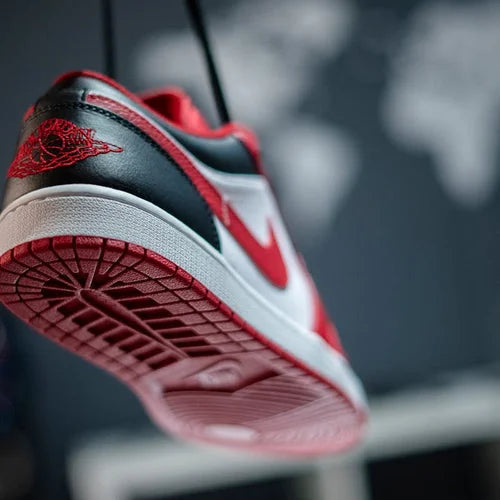
Fake vs Real Jordan 5: How to Tell If Your Jordan 5s Are Fake

Dernière mise à jour le :
Spotting a fake Jordan 5 starts with knowing which release you have, because the heel logo, the tongue and the outsole change from one retro to the next. This fake vs real Jordan 5 guide shows how to tell if Jordan 5s are fake in any colorway: check the release and style code, then the overall shape and stitching, the netting and shark teeth, the heel, the tongue, the outsole, the size tag and the box label.
The comparison photos below show the Air Jordan 5 "Jade Horizon", style code DC7501-300. The checks apply to every Jordan 5, but always compare your pair with a genuine pair of the same release.
Table of Contents
[ open ]Which Jordan 5 Do You Have?
The Air Jordan 5 has been retroed in dozens of colorways, and each release has its own style code, materials and heel logo. Read the style code on the size tag and the box label first, then compare your pair only with photos of that release.
| Release | Style code | Released | Heel logo |
|---|---|---|---|
| Jade Horizon (the pair in our photos) | DC7501-300 | April 2022, reported at $190 to $200 | Jumpman |
| Black Metallic Reimagined | HF3975-001 | 8 February 2025, $210 | Check retail photos |
| Grape | Check the tag | 21 June 2025, $210 | Nike Air, for the first time on a Grape since 1990 |
| Fire Red "Black Tongue" | HQ7978-101 | 13 September 2025, reported at $210 to $215 | Nike Air |
| Black / University Blue | DD0587-008 | Reported for 2026 | Check retail photos |
Collaborations have their own guides: the Jordan 5 Raging Bull, the Off-White Jordan 5 Sail and the Off-White Jordan 5 Black.
The Overall Look and Stitching

Begin by comparing the whole shoe with official images from Nike or a trusted retailer for your release. Look at the shape first: the height of the collar, the curve of the heel and the line of the midsole. Then check that the upper material matches the release, because Jordan 5s come in leather, suede and nubuck depending on the colorway.
Next, follow the stitching. On a genuine pair, the double rows around the netting and along the overlays run evenly and keep the same distance from the edge. On the fake in our photo, the rows wander and the gap between them changes, most visibly around the netting panel. A single uneven stitch is not enough to call a pair fake, because retail pairs have small flaws too.
The Netting and Shark Teeth
Most Jordan 5s have a translucent netting panel on the side and the "shark teeth" graphic on the midsole, both taken from the 1990 original. Compare the size and spacing of the holes in the netting with a genuine pair, and check that the panel sits in the same position against the overlays.
Then look at the shark teeth. Their points should be sharp and their shape should match a genuine pair of the same release. Some releases add a speckle print on the teeth, as the Jade Horizon in our photo does, and speckle varies from pair to pair, so judge the shape of the teeth, not the number of spots. Authenticators also compare the stitch density along the midsole, but better fakes have fixed it.
The Toe Box
The toe box of a genuine Air Jordan 5 has a specific shape, not too boxy and not too slim. Many fakes have a toe that is too peaked or too round. Compare the toe from the side and from the front with a genuine pair of the same size, because toe shape also changes a little with size and between releases.
The Heel: Jumpman or Nike Air

First, match the heel logo to the release. Some Jordan 5s carry an embroidered Jumpman on the heel, as the Jade Horizon above does. OG-style retros such as the 2025 Grape and the 2025 Fire Red carry Nike Air instead. Neither logo is a sign of a fake on its own. It is only a problem when the logo does not match the style code on the tag and box.
Then check the embroidery. On the genuine pair, the Jumpman is neatly stitched and well proportioned, with thin, clean limbs. On the fake we compared, the stitching is denser and rougher and the figure looks heavier. Look at the stitched line above the heel as well, which wanders more on the fake. Most Jordan 5s also have an embroidered "23" on the outer side of the heel. Check whether your release should have one, and if it does, that it is neatly stitched.
The Tongue
The Jordan 5 tongue is padded, stands tall and carries an embroidered Jumpman near the top. On many releases the tongue is made of reflective material, but the tongue material and colour change between releases, so check what your release should have.
Look at the Jumpman on the tongue. It should be clearly defined, well proportioned and stitched without overlapping threads. Authenticators also compare how deep the pressed recess around the Jumpman sits and how thick the tongue padding is, and many fakes overstuff the tongue.
The Outsole

Flip the shoe over. Many Jordan 5s have a translucent or gum outsole, and the Jade Horizon in our photo has a JORDAN wordmark on the rubber at the heel. On the genuine pair, the rubber is smooth and the letters are crisp and evenly spaced. On the fake we compared, the rubber has a coarse, pebbled texture and the letters are less sharp.
Translucent soles yellow and cloud with age on genuine pairs, so the colour or clarity of an icy sole proves nothing either way. Judge the shape of the pattern and the lettering instead.
The Size Tag
The size tag sewn inside the tongue or collar is the busiest label on a pair of Jordans. It shows the size in several systems, the country of manufacture, the style code, a UPC barcode, a short factory code and two dates. Nike has never said what the two dates mean. They are often read as the production window, but that is not confirmed, so treat them only as a rough check that they suit the release. Tags printed from around 2019 often add a QR code, and many genuine older tags have a barcode only. Counterfeiters copy genuine tags field by field, so a tag that agrees with itself shows the label is consistent, not that the shoes are real.
Check that the style code and the UPC on the tag match the box label and the release. A QR code on the tag opens a Nike page, not an authenticity check. See what a Nike QR code and UPC can show.
If your tag has a QR, two details help here. The qr.nike.com page opens the same way for any code in the right format, even one that was never printed on a shoe, so a scan that works says nothing about the pair. And the 13-character code beside the QR uses digits and letters but never the letters I, L, O or U. Nike's own server rejects a code that contains one of them, and a fake tag can print such a code. If you read one of those letters, look again in good light, because a smudged 1 or 0 is easy to misread, then check the code in our Nike and Jordan code checker.
On the genuine Jordan tags we read, both dates fell before the pair's release, the later one by two to five months. Dates that start after the release are a question for the seller, because restocked pairs can carry later dates. Fakes copy the dates of genuine tags too, so dates that fit the release prove nothing alone.
Recent genuine tags also print a patent line, "This product is covered by one or more patents: www.nike.com/patentsvirtualmarking". A fake tag can get that line wrong, so its spelling is one of the things an authenticator compares. Older tags are laid out differently, so a pair without the line is not a fake for that reason.
Are Jordan 5s Made in China or Vietnam Fake?
Jordans are made by Nike's contract factories, mainly in Vietnam, Indonesia and China. Nike's 2025 annual report puts those three countries at about 51, 28 and 17 percent of its footwear. One colorway can come from more than one country, and Nike's own product pages list some Air Jordan models as made in China in one size range and Indonesia or Vietnam in another. So "Made in Vietnam" or "Made in China" proves nothing alone. What matters is that the country, the factory code and the tag layout fit each other and the release, which only a genuine pair from the same release can show.
For the checks that apply to every Jordan model, see our guide on how to tell if Jordans are fake.
The Box and Packaging
Genuine Jordan 5 boxes are sturdy, with a label on one end that carries the shoe's details. Box designs change between releases, so compare the box only with a genuine box from the same release. A flimsy box with smudged print is a warning sign, but a missing or replacement box is not a sign of a fake.
The Box Label
The label on the end of a Jordan box repeats the shoe's details: the model name, the style code, the size, the colorway and a UPC barcode, and recent labels add a QR code. On a genuine pair in its own box, the UPC on the label matches the one on the size tag, while the box QR carries a different code from the tag QR. A second barcode sticker from a resale platform is normal, and so is a regional label on pairs sold in Asia. Box labels are the easiest part to reprint, so compare fonts and spacing only against a genuine box from the same release. A missing or replacement box is not a sign of a fake.
A barcode that scans proves little. Fakes print real Nike UPCs, and a fake barcode passes the barcode's own check digit too. A label can also print a real Nike barcode that belongs to another shoe or size, which is why the barcode, the style code and the size must agree. So check that the UPC on the tag matches the box, then that the number belongs to your style code and size. Recent tags print 14 digits starting with 00 after "UPC", and the box prints 12 digits plus a small two-digit add-on, so drop the add-on and the leading zeros before you compare.
Read every line of the label. Counterfeits often get the larger details right and slip on the small ones, such as smudged characters, a colorway name from another release or spelling mistakes.
A genuine label does not prove a genuine shoe either. In 2025, police in Shanghai broke up a gang that had sold about 3,400 pairs of sneakers built from genuine and fake parts.
How to Not Get Scammed When Shopping for Jordan 5 Online
Most fake Jordan 5s are sold online, where you only see photos until the pair arrives. Before you pay:
- Buy from reputable sellers: Stick to known retailers or platforms with an authenticity guarantee and a return policy.
- Research the seller: Look at reviews and past transactions.
- Ask for additional photos: Get the size tag, the heel, the tongue, the outsole and the box label, taken in daylight.
- Cross-check prices: A price far below the market for that release is a warning sign.
- Be cautious of "factory variants": Sellers often use the phrase for fakes.
- Use payment methods with buyer protection: It helps if you end up with a counterfeit.
Frequently Asked Questions
Should my Jordan 5 have Nike Air or a Jumpman on the heel?
It depends on the release. OG-style retros such as the 2025 Grape and 2025 Fire Red have Nike Air, while other retros, such as the Jade Horizon, have a Jumpman. Check which one your style code should have (see The Heel: Jumpman or Nike Air).
Do all Jordan 5s have a reflective tongue?
No. Many do, but the tongue material changes by release. Check genuine retail photos of your release.
How do you tell if Jordan 5 Black Metallics are fake?
Confirm the release first: the 2025 Black Metallic Reimagined reads HF3975-001 on the size tag and box. Then run the same checks against a genuine pair of that release: the stitching, the netting and shark teeth, the heel, the tongue, the outsole and the labels.
Why is the icy sole on my Jordan 5 yellow?
Translucent soles yellow with age on genuine pairs. A yellow sole is normal on an older pair and is not a sign of a fake.
Are Jordan 5s made in China fake?
No. Genuine Jordan 5s are made in Vietnam, Indonesia and China (see Are Jordan 5s Made in China or Vietnam Fake?).
What are the most popular Air Jordan 5 models?
The Fire Red, Grape, Black Metallic and Raging Bull are among the best-known colorways, and the Off-White collaborations draw a lot of attention too. Each has its own details, so use a guide for your release where one exists.
Where Can I Get My Jordan 5s Authenticated?
If you are still unsure after these checks, send clear photos of both shoes from the side, the netting and midsole, the heel, the tongue, the outsole, the size tag inside each shoe and the box label. LegitGrails authenticates Jordan from photos you upload, with results in under 30 minutes and a digital certificate with every order.
If your Jordan 5s fail any of these steps, send photos to our Jordan authentication service.
Articles similaires

Jordan 5 Raging Bull Real vs Fake: 2021 Retro Guide
7 minute read.
Real vs Fake Jordan 4 Military Black
8 minute read.
Jordan 11 Jubilee Real vs Fake
5 minute read.
Jordan 11 Concord Real vs Fake: How to Spot Fake Concords
10 minute read.