How to Tell If a Cartier Tank Is Real
To tell a real Cartier Tank from a fake, work from the caseback forward. Read the hallmark punches first, because an authentic punch resolves into separate readable elements while a counterfeit punch collapses into a blob. Then read the character formation in the reference and serial block, where authentic characters are struck and displace metal. Then read the clasp cut-out corners and the crown bead row. The dial is the last thing to trust, not the first.
The Cartier Tank has been in production, in one case shape or another, since 1917, which means the reference you are holding may be one of dozens of variants across steel, gold and silver, quartz and automatic, strap and bracelet. That variety is the counterfeiter's cover, because almost any oddity can be waved away as "a different reference." The way out of that trap is to judge how a marking was made rather than what it says.
| Checkpoint | What to Inspect | Reliability |
|---|---|---|
| Caseback Punches | Whether each punch resolves into separate elements or fills in | ★★★★★ |
| Reference and Serial | Struck characters that displace metal versus flat ablated ones | ★★★★★ |
| Clasp Cut-Out | Corner sharpness, symmetry of the two notches, edge burr | ★★★★ |
| Clasp Script | Stroke width, valley floor, halo of displaced metal | ★★★★ |
| Crown and Cabochon | Bead row evenness, flute wall parallelism, dome profile | ★★★★ |
| Booklet Language Block | Spelling and completeness of the instruction line | ★★★★ |
How the Tank Differs From Its Cartier Siblings
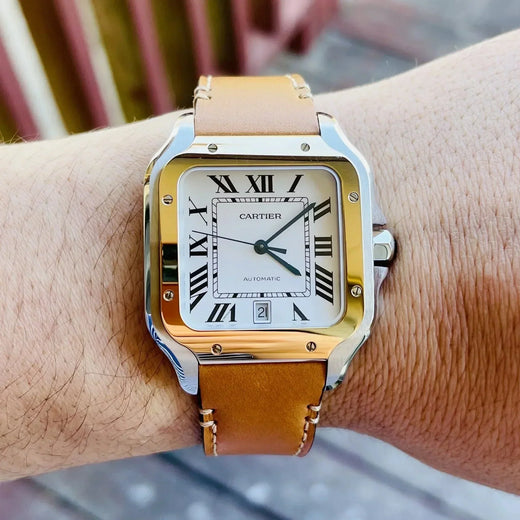
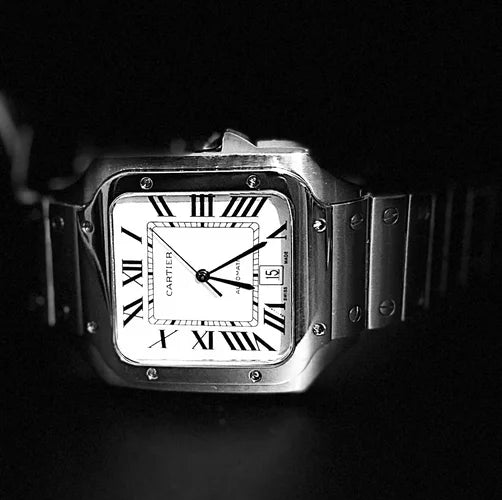
The Tank is defined by its brancards, the two vertical rails that run past the dial and carry the strap directly. The Santos puts exposed screws on the bezel and has no brancards. If your case has screws in the bezel corners you are not looking at a Tank, and the checkpoints below still apply but the reference comparison does not. For the wider brand method across jewelry and watches, see our Cartier watch authentication guide, the Love ring guide and the Juste un Clou guide.
Why the Cartier Tank Is Heavily Counterfeited
The Tank is a rectangle with Roman numerals and blued hands. There is no rotating bezel, no chronograph, no complication display and no exotic material on the core references. That simplicity is the point of the design and it is also why the model is copied more than almost anything else Cartier makes. A counterfeiter has to reproduce a flat printed dial and a plain case rather than a mechanism.
Demand does the rest. The Tank is the entry point into Cartier for many buyers, secondhand supply is deep, and much of it sells privately from photographs. The OECD's 2025 report on global trade in fakes places watches among the highest value counterfeit categories seized, the Federation of the Swiss Watch Industry has run enforcement programs against this trade for decades, and U.S. Customs and Border Protection reports watches every year in its seizure statistics.
Caseback and Case Engravings

The decisive tell on a Cartier caseback is punch resolution. An authentic hallmark punch resolves into separate outlined elements with open interiors even at moderate magnification. On the counterfeit the same punches collapse, so individual shapes merge into a single mass with closed centers.
- Flower punch. On the authentic back each petal is a separately outlined shape with an open center and the leaves taper to points, on the counterfeit the petals are solid dots crowded into a cluster and the leaves are wide rounded loops.
- Octagonal punch. The authentic octagon has straight sides and a complete border, and the figure inside has a readable head and eye. The counterfeit octagon wavers, breaks along one side, and its interior is a smeared mass.
- Script signature. The authentic script is cut with thin even strokes and a fine tail, the counterfeit script is broader with strokes that change width inside a single letter and a fatter bowl on the initial capital.
- Line alignment. The authentic text block centers every line on one vertical axis with even leading, the counterfeit block drifts left of that axis and the leading tightens between two of the lines.
Do not decode the serial string on the back. Both sides of this pair carry a plausible looking number, and a counterfeit that has copied a real format tells you nothing. What a counterfeit cannot copy cheaply is the tooling that formed the punch, which is why resolution beats content every time.
| Element | Authentic | Counterfeit |
|---|---|---|
| Flower punch | Outlined petals, open centers | Solid dots merged into a cluster |
| Octagon punch | Straight sides, complete border, readable figure | Wavering border, broken side, smeared interior |
| Script | Thin even strokes, fine tail | Broad strokes of changing width |
| Text block | Centered on one axis, even leading | Drifts left, leading tightens |
| Serial content | Not a tell, both carry a plausible string | |
Photograph the caseback square on with a single light source off to one side, then zoom until one punch fills the frame. You are judging whether the interiors stay open, not whether the shape looks right.
Your luxury, authenticated
Get independent authentication for your luxury items
Crown and Cabochon

The crown carries two separate tests that do not depend on the stone at all. The bead row should be a line of equal beads parallel to the case edge, and the flutes above it should have parallel walls of equal width.
- Bead row. Authentic beads are fully formed, matched in size and separated by a clear valley, counterfeit beads vary in size and several merge into their neighbors. Judge the beads against each other rather than against the case edge, because the two crowns here are photographed at different angles.
- Flute geometry. Authentic flutes are straight-sided slots of equal width with square-cut ends, counterfeit flutes vary in width and the wall between adjacent slots is thicker on one side than the other.
- Dome profile. The authentic cabochon is a smooth continuous dome with no facet break across the crest, the counterfeit dome is taller and carries a visible ridge and a flat area over the top.
- Seating. The authentic stone disappears cleanly into its collar so no girdle shows, the counterfeit stone stands proud with a visible line where it meets the setting.
Stone color is not usable here. The two samples carry different stones, so anyone treating the color of the cabochon as the test is describing the sample rather than the counterfeit. Cut and seating are the claims that survive.
| Element | Authentic | Counterfeit |
|---|---|---|
| Bead row | Equal beads, clear valleys, parallel to the case | Unequal, merging, running off angle |
| Flutes | Equal width, parallel walls, square ends | Varying width, uneven walls, rounded ends |
| Dome | Continuous curve, no facet break | Taller, ridged, flat over the crest |
| Seating | Girdle hidden in the collar | Stands proud, visible seam |
| Stone color | Not usable, the two samples differ | |
Turn the watch so the crown is silhouetted against a plain background and compare each bead against its neighbours rather than against the case edge, which the camera angle will distort for you.
Bracelet and Deployant Clasp

The clasp blade gives you two independent reads on one small area. The cut-out corners tell you how the blade was machined, and the script tells you how it was marked. On this pair both fail in the same direction, toward softness.
- Cut-out corners. The authentic aperture turns through crisp right angles with only a tiny tool radius, the counterfeit corners are rounded off and one shows a raised burr along the edge.
- Script strokes. The authentic script is cut thin with sharp walls and a clean valley floor, the counterfeit strokes are broad and shallow with rounded bottoms and a halo of displaced metal around them.
- Script placement. The authentic script sits centered between the two cut-outs with clear margin on both sides, the counterfeit script is larger relative to the blade and crowds the lower cut-out.
| Element | Authentic | Counterfeit |
|---|---|---|
| Cut-out corners | Crisp right angles, tiny tool radius | Rounded, burr on one edge |
| Script strokes | Thin, sharp walls, clean floor | Broad, shallow, haloed |
| Script placement | Centered with margin both sides | Crowds the lower cut-out |
Open the clasp out flat and hold it under a lamp at a shallow angle. Both the corner cuts and the script give themselves away in the shadow they throw, not in the outline you see head on.
Don't guess - know for sure
From $15 for 12-hour, up to $35 for 30-minute
Reference and Serial Numbers

This is the most valuable checkpoint on a Cartier Tank and it is also the most misunderstood. Authentic characters here are struck, so metal is displaced and each character has a raised shoulder, a bright top edge and a dark floor. The counterfeit characters are flat and uniform, sitting in shallow depressions with diffuse edges.
- Character relief. Authentic characters show a shoulder of displaced metal around them, the counterfeit characters have no shoulder and the surface stays level right up to the stroke.
- Brushing behavior. On the authentic block the brushing grain is crushed and interrupted inside each character. This one needs good light and a steady macro frame to read, so treat it as confirmation rather than as the check you lead with.
- Digit counters. In the authentic crops the bowls of the digits are open with defined inner walls, in the counterfeit crops the bowls fill in and the terminals round over.
- Stroke uniformity. Authentic strokes vary slightly in width across a character. A perfectly even stroke width is what a cutting path looks like rather than a punch, though this is the hardest of these bullets to judge from a photograph.
- Shared content. Both sides carry the same trailing four-digit group. A number that matches a reference list is not evidence of anything on its own.
A Cartier serial number is worth checking, but check it for what it can actually tell you rather than as a pass or fail. Our Cartier serial number checker reads the format of the code you enter and reports the production period it corresponds to, or tells you plainly when the code does not resolve. A code that does not resolve is a question, not a verdict.
Two practical notes. Photograph the block square on under one diffuse light source, because raking light exaggerates depth and flat light hides it, and depth is the whole point of this check. And enter the code exactly as it reads including letters, since transcription errors are the most common reason a genuine code fails to resolve.
| Element | Authentic | Counterfeit |
|---|---|---|
| Relief | Displaced shoulder around each character | No shoulder, surface stays level |
| Brushing | Crushed and interrupted inside characters | Reads continuously across the floors |
| Digit counters | Open bowls, defined inner walls | Filled bowls, rounded terminals |
| Stroke width | Slight variation within a character | Uniform, cutting-path even |
| The number itself | Not a tell, both carry the same trailing group | |
Rake the light across the characters from the side instead of lighting them from above. A struck character casts a shadow off its own raised shoulder and an etched one has no shoulder to cast it.
Papers and Hang Tags

The instruction booklet cover is the most reliable paper check on this pair, because it is a typeset document and a typesetting error cannot be explained away as a variant. The counterfeit misspells a Spanish word and mangles a Turkish word. Those are the decisive findings, because Cartier does not ship a typo. It also carries a shorter language block, which is weaker evidence.
- Spanish entry. The authentic line reads "Modo de empleo", the counterfeit reads "Mode de empleo", which is a straight substitution of one vowel.
- Turkish entry. The authentic line carries the correct Turkish diacritics, the counterfeit replaces the final character with a lowercase L so the word ends incorrectly.
- Greek entry. The authentic block closes with a Greek entry and the counterfeit block ends without it. Treat this as supporting only, because Cartier has changed the language set across booklet editions and markets, so a shorter list can be a different printing rather than a fake.
- Rule row. The authentic decorative row under the script is built from fine hairline dashes with small filled blocks, the counterfeit dashes are heavier, the blocks are larger and the spacing between them is wider.
- Hang tags prove nothing. The counterfeit side of this pair arrives with an oval hang tag on a cord and a sealed barcode card. Their presence is not evidence, only their print quality is.
Paperwork is the fastest thing in this entire guide to fabricate and the fastest to swap, so it should never carry a verdict on its own. A booklet with a typesetting error is disqualifying. A booklet that reads correctly proves nothing.
| Element | Authentic | Counterfeit |
|---|---|---|
| Spanish entry | Modo de empleo | Mode de empleo |
| Turkish entry | Correct diacritics | Final character replaced |
| Greek entry | Present, closes the block | Absent, line ends short |
| Rule row | Hairline dashes, small blocks | Heavier dashes, larger blocks, wider gaps |
| Hang tag | Present on both, not a tell | |
Work through the booklet cover language by language with a translation open beside you, reading word by word. You are proofreading a typeset document, and scanning it is how the errors get missed.
Authenticate Your Items
Thousands rely on us to authenticate designer items, join them today
Red Flags That End the Inspection
A hallmark punch that has filled in ends the inspection. Every other finding here is a judgment about degree, but a punch whose interior elements have merged into a single mass was made by a different tool than the one Cartier uses.
- Punch interiors closed. Petals reduced to solid dots, or a figure inside an octagon that cannot be resolved at all.
- A typesetting error in the papers. A misspelled language entry is not a regional variant, it is a reprint of a reprint.
- Characters with no displaced shoulder. If the brushing grain runs uninterrupted through the character floors, the block was not struck.
- Rounded clasp cut-out corners with a burr. Soft corners plus a raised edge means the aperture was punched and never finished.
- A bead row that is not parallel to the case edge. Beads of unequal size running off angle is a casting fault, not wear.
What Current Counterfeits Get Right
The counterfeit in this set gets the full four-line caseback text right, gets a plausible serial format right, gets the clasp cut-out shape right, carries a cabochon crown, and arrives with a booklet, a hang tag and a barcode card. Read at the resolution of a listing photo, none of that separates it from the authentic sample.
What it still cannot do is hold a tolerance repeatedly. Every failure above is one of consistency rather than design: a punch that closed, a corner that rounded, a stroke that spread. That is why content-based checks such as reading a serial string keep getting people into trouble.
What You Can Check Yourself and What You Cannot
Two checks in this guide transfer cleanly to photographs you take yourself: the language block on the booklet, which needs no magnification at all, and the clasp cut-out corners. Punch resolution and struck-versus-flat character formation need controlled lighting and a reference set, because both of them look identical in the wrong light.
LegitGrails authenticates from photographs, so the constraint is the same on our side. What separates a trained read from an untrained one is the library of paired references behind it, not access to the watch. If the number matters to you, run the code through our Cartier serial number checker and send the caseback and clasp frames for a second read before money moves.
Get 20% Off Your First Authentication
Free authentication guides and expert tips
No spam. Unsubscribe anytime. Privacy Policy
Frequently Asked Questions
How to spot a fake Cartier Tank?
Start at the caseback. On an authentic Tank the hallmark punches resolve into separate outlined elements with open interiors, while a counterfeit punch fills in and reads as a blob. Then check that the reference and serial characters show a shoulder of displaced metal rather than sitting flat in a shallow depression.
Where is the Cartier Tank serial number?
On the Tank the serial and reference sit on the caseback, either engraved directly into the back or on a plate set into it. Some references carry a second block on the inside of the clasp or on the lugs, which is why the whole back should be photographed rather than one line.
Can I do a Cartier tank serial number lookup online?
Yes. Our Cartier serial number checker reads the code format and reports the production period it corresponds to, and says so plainly when a code does not resolve. Cartier Care also runs the manufacturer's own verification service.
Does a Cartier Tank serial number prove it is real?
No. Counterfeits routinely carry serials in a correct format, and the pair in this guide even shares the same trailing four-digit group. A serial tells you what the code claims. Only how the characters were formed tells you whether the case is genuine.
What is the difference between a Cartier Tank real vs fake caseback?
Punch resolution and text alignment. The authentic back keeps every line centered on one axis with even leading and every punch readable as separate elements. The counterfeit block drifts off axis, tightens its leading between two lines, and its punches close up.
Is a Cartier Tank dupe the same thing as a fake?
No. A dupe is an unbranded rectangular watch sold as itself, with no Cartier script, no hallmarks and no serial. A counterfeit copies the marks and is sold as a Cartier. Only the second one is what this guide is about, and only the second one carries a real financial risk.
Is a Cartier Tank Francaise fake vs real check different from other Tanks?
The checkpoints are the same. Punch resolution, character formation, clasp machining and crown geometry apply across the Tank family regardless of case size, metal or movement. What changes between references is which markings are present, so compare against the same reference rather than the family.
Do fake Cartier Tanks come with box and papers?
Frequently. The counterfeit in this photo set arrived with a booklet, an oval hang tag on a cord and a sealed barcode card. Paperwork can disqualify a watch when it carries a typesetting error, but it can never confirm one.
How much does Cartier Tank authentication cost?
Professional Cartier authentication from LegitGrails costs $15 to $35 depending on turnaround, from 12 hours down to 30 minutes. Each item is reviewed by up to 4 brand experts from your photographs. For another piece read through a brand mark cut into metal, see our Return to Tiffany necklace guide. For a hard accessory where the same lettering is printed on rather than cut in, see our Prada Symbole sunglasses guide.