Jordan 1 Bred Toe Real vs Fake (555088-610)

Última actualización:
To tell a Jordan 1 Bred Toe real vs fake, confirm first that you have the High OG and its style code, then check the box and paperwork, the leather, the Wings logo on the collar, the stitching, the Swoosh, the toe box, the outsole, the heel shape, the insole and finally the size tag and box label. Compare every detail with a genuine Bred Toe, because a good fake passes most checks and fails one or two.
This guide covers the Air Jordan 1 Retro High OG "Bred Toe", style code 555088-610, in Gym Red, Black and Summit White. It released on 24 February 2018 at $160, and the grade school pair is 575441-610. Two other Bred Jordan 1 Highs are often confused with it, the Jordan 1 Bred "Banned" 2016 and the Jordan 1 Bred Patent, and each has its own guide.
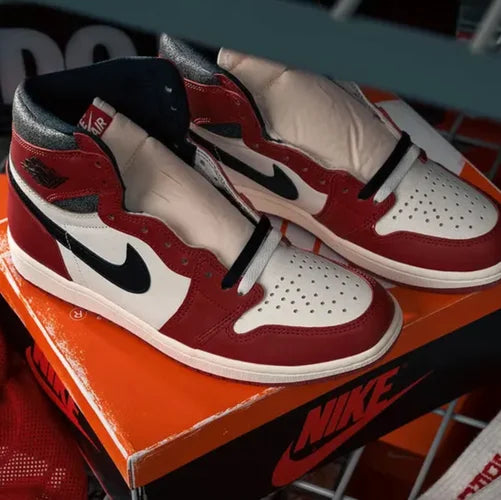
The photos in this guide show genuine reference pairs only, so use them as the standard to compare a pair against.
Table of Contents
[ open ]Which Bred Jordan 1 Do You Have?
Several Jordan 1 Highs carry the black and red "Bred" colors, and each has its own style code, materials and box. Read the code on the size tag before you compare anything:
- Bred Toe (this guide): 555088-610, with a red toe, black overlays and a white side panel, 24 February 2018 at $160.
- Bred "Banned" 2016: 555088-001, black and red leather with no white panel, 3 September 2016 at $160.
- Patent Bred: 555088-063, black and red patent leather, December 2021.
- Air Jordan 1 High '85 "Bred": HV6674-067, February 2025, with a higher collar and a larger Swoosh. It is a different shape, so the checks here do not apply to it.
High or Low Bred Toe?
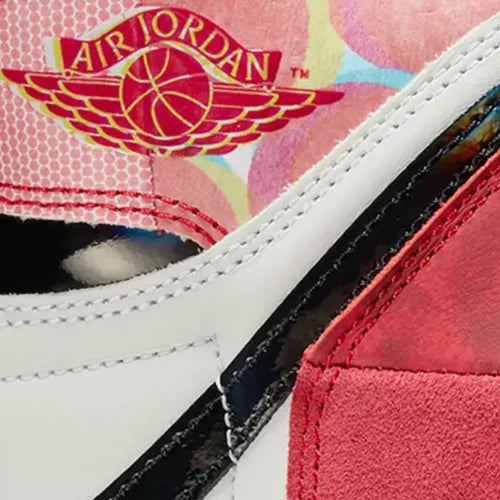
Jordan also made an Air Jordan 1 Low "Bred Toe", style code 553558-612, released in December 2021 at $100. It is a different shoe with a different cut, and its Wings logo is embroidered on the heel rather than stamped into the ankle collar as on the High. The photo below shows that embroidered logo on a genuine Low.
The checks in this guide are written for the High OG. The general ideas, such as even stitching, a clean perforation pattern and matching tag and box codes, also apply to the Low, but compare a Low only with a genuine Low.

Box, Receipt and First Look
Start with what came with the pair. A receipt or an order confirmation from a known retailer is useful, so check that the retailer name, the date and the product match the shoes.
The box comes next. Pairs sold second hand often lose their box or arrive in a replacement, so a missing box is not a sign of a fake. When the box is there, read its label against the size tag, as explained in the box label section below.
Some buyers also smell the shoes. A strong chemical smell is worth asking about, but smell alone proves nothing, because glue odour changes with the factory, the age of the pair and how it was stored.
Our website has a general Jordan 1 guide, so check it for the points every Jordan 1 shares.
The Leather
The upper of a genuine Bred Toe is leather. Many current fakes use leather too, so the old idea that a fake is always made of synthetic material no longer holds.
Look at close-up photos of the toe box, the overlays and the side panel. Genuine leather shows an irregular grain with small natural marks, while a printed synthetic grain repeats the same pattern across the panel. Leather texture varies from pair to pair and creases with wear, so compare the grain with a genuine Bred Toe and treat it as a supporting check rather than a verdict.
The Wings Logo
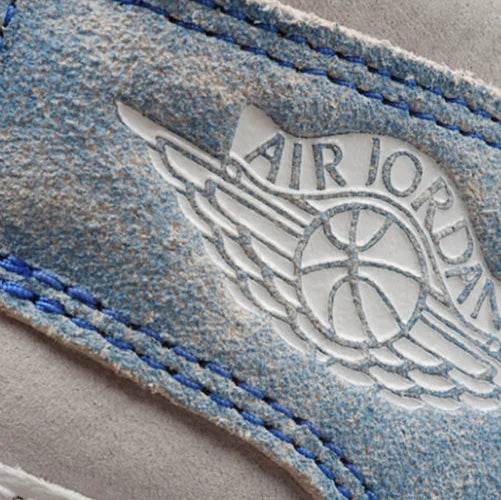
On the High OG, the Wings logo is stamped into the leather of the ankle collar. Look at its overall shape, the spacing of the letters in AIR JORDAN, the small TM marks and where the logo sits against the collar stitching.
The depth of the stamp varies between pairs and softens with wear, so judge the logo by how even and crisp it is, not by how deep it looks.
Lettering
The letters of AIR JORDAN should be evenly spaced and of a consistent thickness across the word. Letters that crowd together, thin out or drift off the curve are a reason for a closer look.
Wings
The wings should be symmetrical and set clear of the stitching around the collar. A common fault on fakes is a logo placed too close to the stitching or wings whose feather pattern does not match a genuine pair.
The Stitching

Follow the stitch lines along the overlays, around the Swoosh and along the heel. On the genuine pair in the photo, a Low Bred Toe, the stitches are short, even and sit tight in the leather, and each line runs parallel to the edge it follows.
Stitch length and thread vary a little between factories and batches, so a slightly different count is not a red flag. Stitching that wanders, bunches, doubles back or leaves loose threads at the ends is a reason to look closer.
The Swoosh
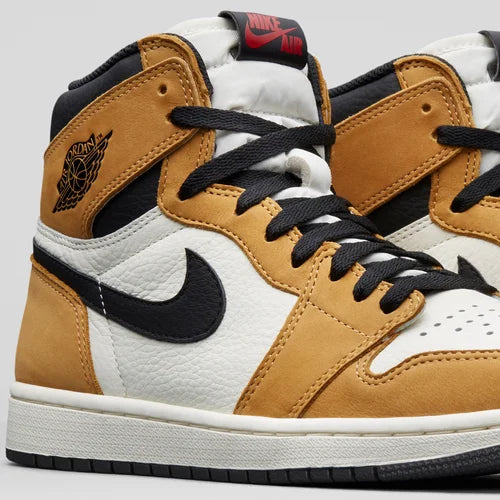
Check the Swoosh for its shape, its stitching and where it sits. On a genuine pair the tip is pointed and cleanly cut, the edges are smooth and the curve flows into the heel without a kink.
Compare its position with a genuine Bred Toe, for example how high the top of the Swoosh rises toward the lower eyelets. A Swoosh that is too fat, too short or cut with ragged edges is a common fault on fakes.
The Toe Box
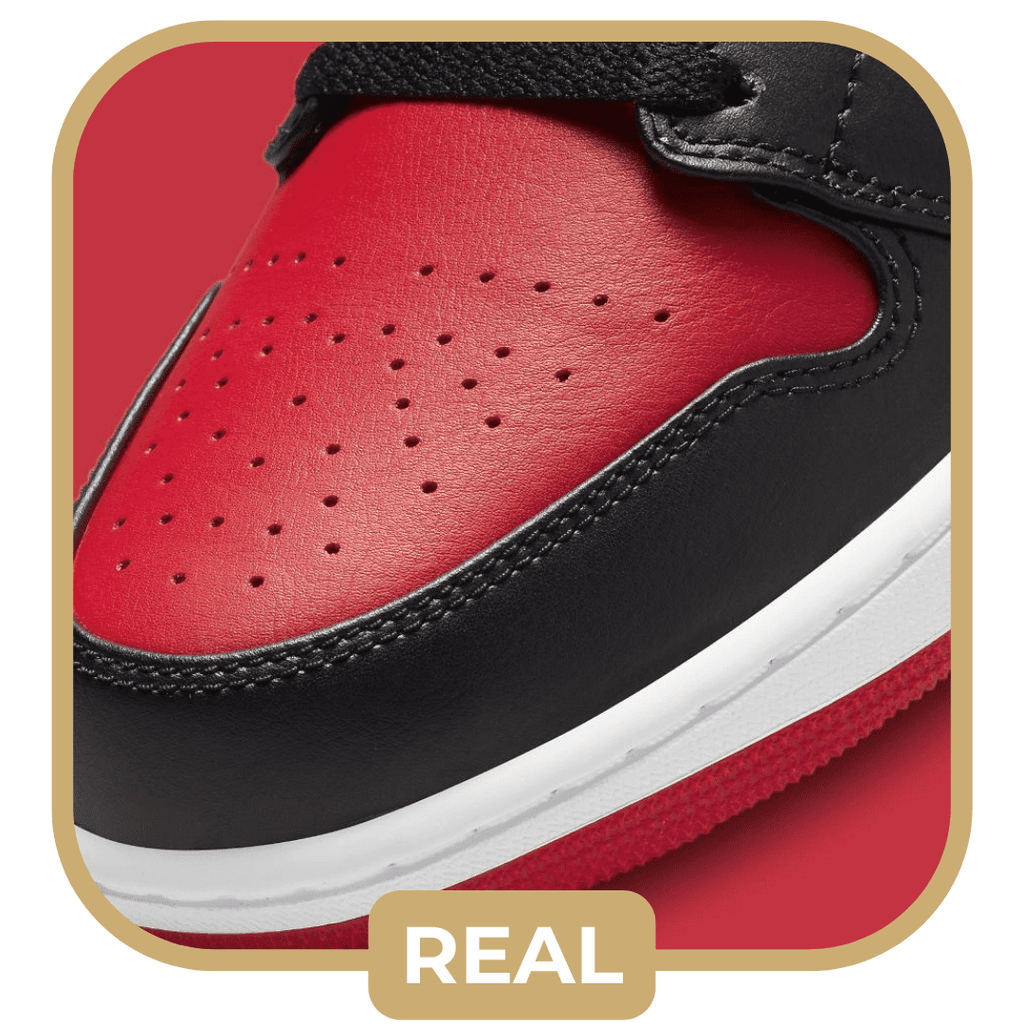
The red toe gives the Bred Toe its name, so it is worth a careful look. Check two things: the perforations and the shape.
Perforations
Genuine pairs have small perforations punched in a regular pattern, with even gaps between the holes and between the outer row and the seams. On many fakes the holes are larger, uneven or crowd the seams. Authenticators also check the star-like layout of the holes near the tip, so compare the pattern hole by hole with a genuine pair.
Shape
From the side, a genuine High OG toe box is slim and slopes down toward the tip. A fake toe box that sits high and looks inflated is a common fault. The Jordan 1 Chicago guide shows the same toe box and perforation checks on a pair with similar color blocking.
The Outsole
Turn the shoe over and look at the texture and the tread pattern. On a genuine pair the rubber has a fine, even grain, and the circles and grooves of the tread are cut with clean, straight edges.
A tread with coarse grain, soft edges or grooves that wander is a reason for a closer look. Authenticators also compare the spacing of the outsole grooves with a genuine pair. Judge the pattern, not the shade of red, because color changes with light, the camera and age.
The Heel Shape
Look at the shoe from behind. A genuine Jordan 1 High usually narrows around the middle of the heel and widens again toward the collar and the sole, the shape collectors call the hourglass. Many fakes run straight up and down. The depth of the hourglass varies by release and factory, and some genuine pairs are closer to a straight funnel.
Wear, storage and shoe trees change the heel, so judge this only on an unworn or lightly worn pair, and check that the heel stitching is even on both sides.
The Insole
Lift out the insole if you can. Check that the logo print on top is sharp and centred, and then look at the underside.
On genuine pairs the underside usually shows neat, regular glue lines. On one fake Bred Toe, the glue strips were yellow and the foam more porous. That is a single pair, so treat it as one more data point rather than a rule.
The Size Tag
The size tag sewn inside the tongue or collar is the busiest label on a pair of Jordans. It shows the size in several systems, the country of manufacture, the style code, a UPC barcode, a short factory code and two dates. Nike has never said what the two dates mean. They are often read as the production window, but that is not confirmed, so treat them only as a rough check that they suit the release. Tags printed from around 2019 often add a QR code, and many genuine older tags have a barcode only. Counterfeiters copy genuine tags field by field, so a tag that agrees with itself shows the label is consistent, not that the shoes are real.
Reading the tag on a Bred Toe
On an adult pair the tag should read 555088-610, and on a grade school pair 575441-610. The dates should be plausible for a February 2018 release, and since the pair came out before the QR tags described above, a barcode-only tag is normal on it.
Then check the printing. Compare the font, spacing and alignment of the text with a genuine Bred Toe tag.
Code checks that can expose a fake Jordan 1 Bred Toe
No code can prove a pair is real, but these checks can expose a fake label:
- The barcode belongs to 555088-610. The 14-digit number after "UPC" on the tag is Nike's barcode for one style code in one size. A fake label can carry a real Nike barcode that belongs to another colorway or size, and it still scans. An authenticator checks that the barcode is Nike's number for 555088-610 in the size printed beside it.
- The tag and the box agree. The box label prints the same barcode with one leading zero instead of two, plus a small two-digit add-on. Ignore the zeros and the add-on, and the digits should match the tag. A mismatch is a question for the seller, not proof, because genuine pairs end up in other boxes.
- The QR code uses Nike's alphabet. The 13 characters printed beside the QR use the digits 0 to 9 and every letter except I, L, O and U. Nike's own QR server rejects any code that contains one of those four letters, and a fake tag can print them. A well-formed code proves nothing, because qr.nike.com sends every well-formed code, even an invented one, to the same Nike page and shows no result.
- The dates fit the release. On the genuine Jordan tags we have read, both dates fell before the release, the later one by two to five months. A first date after the February 2018 release is a reason to ask whether the pair is a restock, not proof of a fake. Some fakes copy genuine dates exactly, so plausible dates prove nothing either.
- The patent line is spelled right. Recent Nike tags end with "This product is covered by one or more patents: www.nike.com/patentsvirtualmarking". A misspelled line or a different address is one of the things an authenticator compares. Older tags may not carry the line at all.
You can type the style code, the barcode and the QR code into our free Nike and Jordan code checker to run the format and match checks, and our guide to what a Nike QR code and UPC can show explains each code in full.
The Box Label
The label on the end of a Jordan box repeats the shoe's details: the model name, the style code, the size, the colorway and a UPC barcode, and recent labels add a QR code. On a genuine pair in its own box, the UPC on the label matches the one on the size tag, while the box QR carries a different code from the tag QR. A second barcode sticker from a resale platform is normal, and so is a regional label on pairs sold in Asia. Box labels are the easiest part to reprint, so compare fonts and spacing only against a genuine box from the same release. A missing or replacement box is not a sign of a fake.
A Bred Toe label should show 555088-610 and the same size as the tag. Boxes also carry a small date stamp that names the factory. One fake Bred Toe came in a box whose stamp followed another factory's design. Genuine colorways come from more than one factory, so a stamp that differs from your reference is a reason to ask the seller, not proof of a fake.
Frequently Asked Questions
What is the style code of the Jordan 1 Bred Toe?
The Air Jordan 1 Retro High OG "Bred Toe" is 555088-610, and the grade school pair is 575441-610. The Low "Bred Toe" is 553558-612. The code is printed on the size tag and the box label.
Do these checks work for the Jordan 1 Low Bred Toe?
Partly. The Low has a different cut and an embroidered Wings logo on the heel, so the collar logo and heel shape checks here do not apply. Stitching, perforations, the outsole and the tag and box codes can be checked the same way against a genuine Low.
Is the Bred Toe the same as the Jordan 1 Bred "Banned"?
No. The Bred "Banned" 2016 (555088-001) is black and red with no white panel and no red toe. The Bred Toe (555088-610) has a red toe box and a white side panel.
Are the toe box perforations a reliable check?
They are one of the more useful ones, because fakes often get the size and spacing of the holes wrong. Compare the pattern hole by hole with a genuine Bred Toe, and confirm with the other checks before you decide.
Is a Bred Toe without the original box fake?
No. Boxes get lost, damaged or swapped, and a missing or replacement box is not a sign of a fake. Judge the shoes themselves and the size tag instead.
See If Your Jordan 1 Bred Toe Is Authentic
If you are still unsure after these checks, send clear photos of both shoes from the side and from behind, the Wings logo on the collar, the toe box, the outsole, the insoles, the size tags and the box label. LegitGrails authenticates Jordan from photos you upload, with results in under 30 minutes and a digital certificate with every order.
If your Jordan 1 Bred Toe fails any of these steps, send photos to our Jordan authentication service.
Artículos relacionados
Jordan 11 Jubilee Real vs Fake
5 minute read.
Jordan 11 Concord Real vs Fake: How to Spot Fake Concords
10 minute read.