How to Tell If a Hermes Evelyne Is Real
To authenticate a Hermes Evelyne, start with the perforated H. On an authentic bag every hole is a clean round bore of matched diameter at an even pitch. Then check the blind stamp for a shallow impression leaving the grain readable, and the heat stamp for foil seated inside the letterforms.
The Evelyne is Hermes' flat shoulder bag, a single panel with a perforated H punched through the front and a canvas strap running to a clasp at each side. It began as a groom's bag, which is why the perforations are functional in origin. The comparison used throughout this guide reads as the Evelyne III generation.
Size cannot be settled from a photograph of the bag alone. TPM, PM and GM share the same panel geometry and the same perforated H, so a listing photo without a scale reference will not tell you which one you are looking at.
| Checkpoint | What to Inspect | Reliability |
|---|---|---|
| Perforated H | Hole roundness, matched diameter, even pitch, clean bore walls | ★★★★★ |
| Blind Stamp | Shallow impression, grain readable inside characters, mark shape | ★★★★★ |
| Heat Stamp Foil | Foil seated in the impression, straight baselines, tapered line widths | ★★★★ |
| Leather Grain | Irregular cell sizes with no repeating lattice | ★★★★ |
| Silhouette and Tab | Panel taper, base corner radius, keeper fit against the body | ★★★ |
How the Evelyne Differs From Its Hermes Siblings
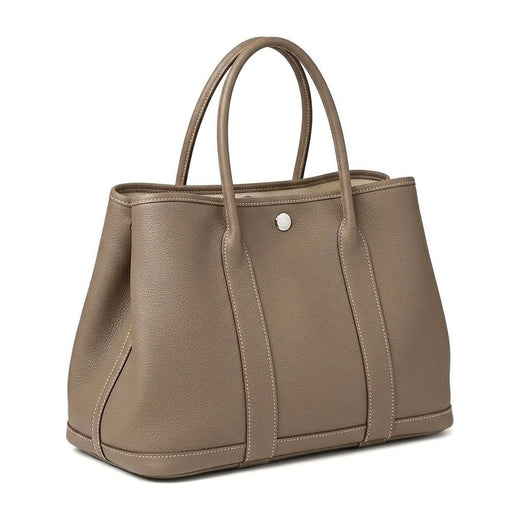
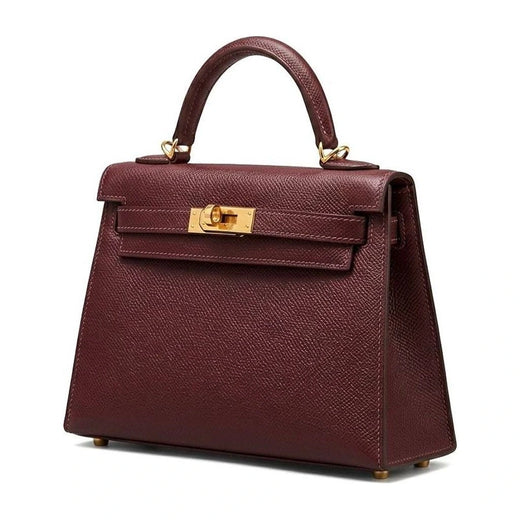
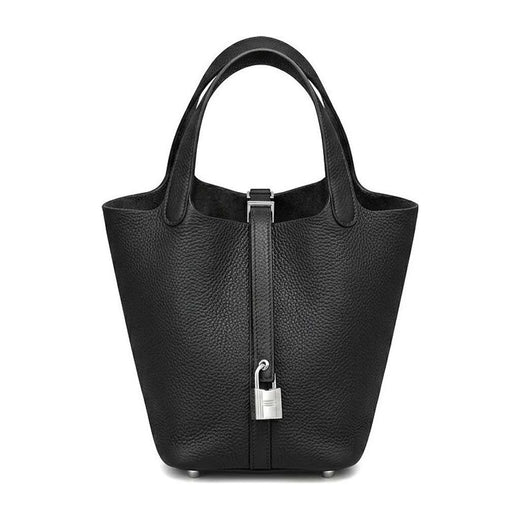
For a Hermes bag of any kind, our broader guide to spotting a fake Hermes bag is the starting point, and this page is where you land once you know the model. The Evelyne's decisive checkpoint exists on no other Hermes bag. The Kelly is authenticated through its closure, sangles and turnkey plate. The Garden Party puts its evidence in the weave and the trim joins. The Picotin Lock relies on a cadenas the Evelyne does not carry. The Evelyne instead hands you a whole motif of punched holes, which is more repeated, measurable geometry than any other model gives you in one photograph. Our Clic H bracelet guide reads the same way about a different object.
Why the Evelyne Is Heavily Counterfeited
The Evelyne is the Hermes bag most people can picture owning. No hardware to speak of, no closure mechanism, no lining structure and a shape that photographs simply, so the manufacturing barrier is lower than on the house's structured bags. Its everyday visibility keeps resale demand steady and makes a copy easy to move.
What counterfeiters underestimate is the perforation. Punching a hundred identical holes through a thick grained hide is a tooling problem, and it is the one part of this bag that cannot be solved by copying a photograph. Leather goods remain among the largest counterfeit categories reported by U.S. Customs and Border Protection, and both the United States Patent and Trademark Office and the International AntiCounterfeiting Coalition track the same concentration in online resale, alongside the EU Intellectual Property Office observatory.
The Perforated H

The perforated H is the strongest checkpoint on an Evelyne. Authentic holes are round, matched in diameter and evenly pitched, and their bores read as clean dark openings. Counterfeit holes vary in shape, several run oval, and their bores show a torn cut edge.
- Hole roundness. Every authentic bore is circular, and on the counterfeit a noticeable share are elongated into ovals whose long axis runs in inconsistent directions.
- Diameter consistency. The authentic holes hold one diameter across the whole motif, while the counterfeit holes range from small to large within the same letter stroke.
- Bore condition. The authentic punch cuts clean, so the opening reads as a dark void with a crisp rim. A pale crescent of exposed cut edge shows inside many counterfeit bores, which is the punch tearing the hide rather than shearing it.
- Pitch regularity. The authentic holes sit at an even gap along every stroke and around the whole ellipse. On the counterfeit the spacing collapses, with pairs nearly touching and other gaps close to double width.
- The ellipse itself. The authentic outer oval is a smooth continuous curve of constant sweep, and the counterfeit oval wobbles, its lower arc flattening where the punched positions drift.
- Light through the panel. The authentic bores read uniformly dark. Several counterfeit holes catch light on the torn edge, so the motif reads inconsistently across its own strokes.
| Element | Authentic | Counterfeit |
|---|---|---|
| Hole shape | Round throughout | Several elongated into ovals |
| Diameter | Matched across the motif | Varies within a single stroke |
| Bore walls | Clean shear, crisp rim, dark void | Torn edge visible inside the bore |
| Hole pitch | Even gaps along every stroke | Pairs nearly touching, other gaps doubled |
| Outer ellipse | Smooth continuous sweep | Wobbles, lower arc flattens |
| Motif consistency | Reads uniformly dark | Uneven, some holes catch light |
Spend your time here, because it is the only check on the bag that repeats. A tooling fault that would be arguable once becomes conclusive when it recurs across a hundred holes. If a seller will supply one close up photograph, this is the one to ask for.
Photograph the H square on and look at the holes as a set rather than one at a time. Roundness and pitch are properties of the group, and a single hole carries no information.
Your items, verified
Get independent authentication for your luxury items
Leather Grain Pattern

Authentic grain does not repeat. On the authentic panel the cells vary in size, shape and height with no traceable pattern, and on the counterfeit the same cell shape recurs on a regular pitch, forming diagonal rows that run across the whole crop.
- Cell size variation. The authentic surface mixes large and small cells with no grouping, while the counterfeit cells cluster around one repeating size.
- Lattice traceability. On the counterfeit crop you can follow identically shaped cells diagonally from corner to corner, which is a pressed pattern rather than a hide. No such line exists on the authentic side.
- Ridge width. The authentic boundaries between cells vary in width and depth along their length, and the counterfeit ridges hold a near constant width, reading quilted rather than pebbled.
- Cell height. The authentic cells sit at differing heights and break light unevenly, and the counterfeit cells rise to a common height, giving a flat uniform relief.
- Internal creasing. Fine creases inside the authentic cells run in random directions and cross cell boundaries, while the counterfeit creasing repeats with the cell shape and stops at its edges.
| Element | Authentic | Counterfeit |
|---|---|---|
| Cell size | Mixed, no grouping | Clustered around one repeating size |
| Pattern | No traceable repeat | Diagonal lattice traceable across the crop |
| Ridge width | Varies along its length | Near constant, quilted appearance |
| Cell height | Uneven, breaks light irregularly | Common height, flat relief |
| Internal creasing | Random, crosses cell edges | Repeats with the cell, stops at its edges |
Scan the panel at arm's length looking for repetition instead of examining any one patch closely. You are hunting a pattern, and patterns only become visible at distance.
Blind Stamp Impression Quality

Read the impression rather than the characters. An authentic Evelyne blind stamp is shallow, small and leaves the grain readable inside every character. The counterfeit stamp is cut larger and deeper, with burnished rims and a mark to the left of a different construction.
- Character height. The authentic characters occupy a modest band on the half moon tab, while the counterfeit characters are taller and wider, filling far more of the same tab.
- Impression depth. The authentic strokes barely break the surface, and the counterfeit strokes sink deep enough to throw a shadow and raise a burnished rim.
- Grain survival. The pebbling continues through the authentic stamped area, and around the counterfeit characters it is pressed flat into a smooth band.
- The mark at the left. The authentic mark is a compact multi armed figure, while the counterfeit reduces it to two plain intersecting strokes.
- Group spacing. The authentic row keeps tight even gaps, and on the counterfeit the gap before the number group opens up wider.
- Tab stitching. The authentic saddle stitch follows the tab's curve at a constant inset, and the counterfeit line wanders from the edge and loosens at the lower corners.
| Element | Authentic | Counterfeit |
|---|---|---|
| Character height | Modest band on the tab | Taller and wider, fills the tab |
| Impression depth | Shallow, barely breaks the surface | Deep, burnished rims, hard shadow |
| Grain inside the stamp | Pebbling continues through | Pressed flat into a smooth band |
| Left hand mark | Compact multi armed figure | Two plain intersecting strokes |
| Group spacing | Tight and even | Widens before the number group |
| Tab stitching | Constant inset around the curve | Wanders, loosens at the corners |
None of this requires decoding what the stamp says. A counterfeit can carry a plausible character string, so the string proves nothing in either direction. How the leather took the die is the evidence.
Angle the leather until you can see whether grain survives inside the characters. Grain flattened into a smooth band means the tool went in far harder than it should have.
Authenticate with LegitGrails
From $15 for 12-hour, up to $35 for 30-minute
Heat Stamp Foil on the Strap Tab

On an authentic Evelyne the three stamped lines taper, each narrower than the one above it, and the foil sits down inside the letterforms. The counterfeit block loses that taper, and its foil lies across the raised grain, skipping wherever the surface rises.
- Line taper. The authentic block narrows line by line into a centered pyramid, and on the counterfeit the bottom line runs nearly as wide as the top one.
- Foil seating. The authentic foil is confined within the pressed letterforms, and the counterfeit foil rides on the grain and breaks up wherever a raised cell interrupts it.
- Character continuity. Every authentic character is complete, while several counterfeit characters have sections missing where the foil failed to transfer.
- Baseline. The authentic lines each sit level, and on the counterfeit the middle line drifts upward toward its right end.
- Block placement. The authentic block sits centered on the oval tab with even side margins, and the counterfeit block is set high and off center.
- Tab stitching. The authentic saddle stitch runs at an even pitch with every stitch at the same slant, and the counterfeit pitch and slant both change along the curve.
| Element | Authentic | Counterfeit |
|---|---|---|
| Line taper | Clear pyramid, each line narrower | Bottom line nearly as wide as the top |
| Foil seating | Inside the pressed letterforms | Rides across the raised grain |
| Characters | Complete throughout | Sections missing mid stroke |
| Baseline | Level on every line | Middle line drifts upward |
| Placement on the tab | Centered, even side margins | High and off center |
| Tab stitching | Even pitch, consistent slant | Variable pitch, changing slant |
Check that each line is narrower than the one above before reading a word of it. The taper is pure geometry and needs no knowledge of what the stamp says.
Your designer items deserve to be verified
>99.89% authentication success rate
The Dust Bag Roundel

On an authentic Evelyne dust bag the carriage roundel is printed into the herringbone twill, so the weave breaks up each line. The counterfeit print lies on top of the cloth as an unbroken film.
- Ink and weave. The authentic print sits into the twill and the herringbone shows through every stroke, while the counterfeit print covers the weave as a solid film with the cloth texture flattened underneath.
- Outer circle. The authentic ring is a fine hairline holding one width the whole way round, and the counterfeit ring is thicker and swells and thins as it travels its arc.
- Carriage wheels. Each authentic wheel has separate spokes you can count out to the rim, and on the counterfeit the spokes run together near the hub into a filled mass.
- The circled H. The authentic H sits centered with clear space between each serif and the ring, and the counterfeit H is set heavier and its crossbar arms reach almost to the ring.
- Ground rule. The authentic line under the carriage is drawn thin and even, and the counterfeit line is laid down noticeably heavier than the artwork above it.
| Element | Authentic | Counterfeit |
|---|---|---|
| Ink on weave | Printed into the twill, texture visible | Solid film over a flattened weave |
| Outer circle | Hairline, one width throughout | Thicker, width varies round the arc |
| Wheel spokes | Separate and countable to the rim | Bleed together near the hub |
| Circled H | Centered with clear space to the ring | Bolder, nearly touching the ring |
| Ground rule | Thin and even | Heavier than the artwork above |
Look for the weave coming through the print. Lines that stay solid, with the twill not breaking them up, mean the print sits on the surface rather than in it.
Red Flags That End the Inspection
Torn bore walls in the perforated H are the most disqualifying finding on an Evelyne. A punch that tears rather than shears leaves the cut edge visible inside the hole, and it repeats across the motif.
- Oval or torn perforations. The holes are the one repeated measurement on the bag, so a fault here is confirmed by its own recurrence.
- A blind stamp deep enough to flatten the grain. Hermes stamps shallow. Depth that crushes the pebbling into a smooth band is a different process, not a different year.
- Heat stamp characters with sections missing. The foil never seated into the impression, which points to a stamp applied to the surface rather than pressed into it.
- A traceable repeat in the leather grain. If you can follow one identical cell shape diagonally across a crop, the surface was pressed from a plate.
- A collapsed line taper on the stamped block. A block whose bottom line matches the width of its top line was set from different artwork.
What Current Evelyne Copies Get Right
Silhouette is no longer a separator. Current copies get the panel taper, the tab and the strap proportions close enough that a full bag photograph settles nothing, and the stitching is neat. A listing photo taken from a meter away will not tell you what you need to know.
What has not moved is tooling. Every check that still works measures how a die or a punch met the leather, which is a manufacturing capability rather than a design detail. That is why a seller who sends one sharp close up of the perforated H has effectively answered the question.
What You Can Check Yourself and What You Cannot
The checks here transfer through a written guide because they are comparative and repeated. Roundness, pitch, depth and taper can all be read from one good photograph. What does not transfer is calibration, meaning how shallow a Hermes blind stamp should be, which comes from working across many authentic references.
LegitGrails authenticates from photographs, so this guide is limited to what an image can carry. I have written nothing about weight or interior structure, because those comparisons are not in the cards this guide is built on, and a checkpoint with no evidence behind it is worse than none.
Get 20% Off Your First Authentication
Free authentication guides and expert tips
No spam. Unsubscribe anytime. Privacy Policy
Frequently Asked Questions
Hermes Evelyne fake vs real: which check is most reliable?
The perforated H. On an authentic Evelyne every hole is round, matched in diameter and evenly pitched, and each bore reads as a clean dark opening. Counterfeit perforations go oval, vary in size within a stroke, and show a torn cut edge inside the bore.
Does the Hermes Evelyne have a serial number?
No. Hermes does not use serial numbers the way other houses do. The Evelyne carries a blind stamp, a small pressed character string on a leather tab. It is not a lookup code, and counterfeits carry plausible strings. The impression quality is the evidence.
Where is the date code on a Hermes Evelyne?
There is no date code in the sense buyers mean. What people call the Evelyne date code is the blind stamp on a small leather tab. What is worth checking is whether the impression is shallow enough that the grain still runs through the characters.
How can I tell an authentic Hermes Evelyne from a replica in photos?
Ask for one sharp close up of the perforated H, one of the stamped leather tab, and one of the strap tab. Round matched bores, a shallow blind stamp with surviving grain, and foil seated inside the letterforms are the findings that settle it.
What is the difference between a Hermes Evelyne dupe and a fake?
A dupe is a similarly shaped crossbody sold under its own brand with no Hermes marking, and it is a legal product. A fake carries Hermes branding it has no right to. A perforated H or a stamped tab puts a listing in the second category.
Is an Evelyne bag dupe worth buying?
That is a budget decision rather than an authentication one, and an unbranded crossbody is a legitimate purchase. The risk is that dupe listings drift into counterfeit territory by adding the perforated motif or a stamped tab.
Can you tell the Evelyne size from a photo?
Not from the bag alone. TPM, PM and GM share the same panel geometry and the same perforated H, so a photograph without a reliable scale reference will not separate them. Size claims from a listing image are inference.
How much does Hermes Evelyne authentication cost?
Professional Hermes authentication from LegitGrails costs $15 to $35 depending on turnaround, from 12 hours down to 30 minutes. Each item is reviewed by up to 4 brand experts. For wider reading, see our Birkin authentication guide and our Hermes belt guide.