Real vs Fake Rolex Oyster Perpetual: How to Tell If Yours Is Real
How to tell if a Rolex Oyster Perpetual is real starts with confirming it is one: a no-date watch with a smooth, domed bezel. Then check three things a photo can show: the applied coronet at 12, the serial on the inner ring at 6 and the etched crown inside the crystal. To spot a fake Oyster Perpetual like the ones in this guide, start with the dial coronet.
The photo above pairs a pink genuine dial with a blue copy, so color and the double batons at 3, 6 and 9 prove nothing in this fake vs real Rolex Oyster Perpetual comparison. Rolex builds the line in five sizes: the 28 (ref. 276200), 31 (277200), 34 (124200), 36 (126000) and 41. The 41 was ref. 124300 from 2020 until April 2025, when ref. 134300 replaced it with a larger crown and thinner lugs. As of November 2026, Rolex's US site lists the Oyster Perpetual 36 at $6,750 and the Oyster Perpetual 41 at $7,050. The 36 and 41 run on calibre 3230, the smaller sizes on calibre 2232.
| Checkpoint | What to Inspect | Reliability |
|---|---|---|
| Dial Coronet at 12 | Prong width against ball size, scaled to the same height | ★★★★ |
| No Date, Smooth Bezel | No date window, no Cyclops, no fluting, dial text matches the model | ★★★★ |
| Rehaut Engraving and Serial | ROLEX around the inner ring, serial centered at 6, same serial as the card | ★★★★ |
| Etched Crown in the Crystal | A dotted coronet above 6 that needs a loupe and raking light to see | ★★★ |
| Caseback and Warranty Card | Solid screw-down caseback, card format for the year, matching serial | ★★ |
How the Oyster Perpetual Differs From the Datejust and Other Rolex Models
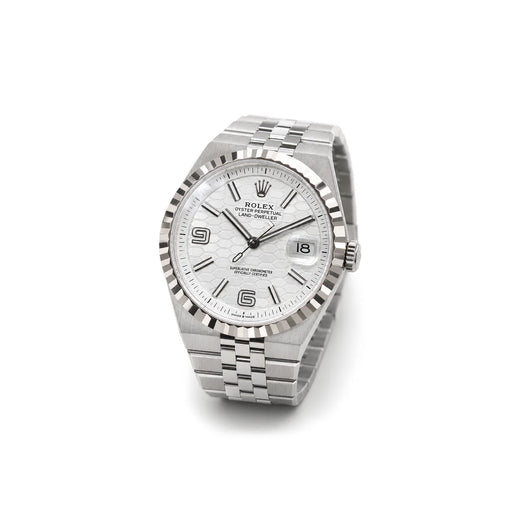
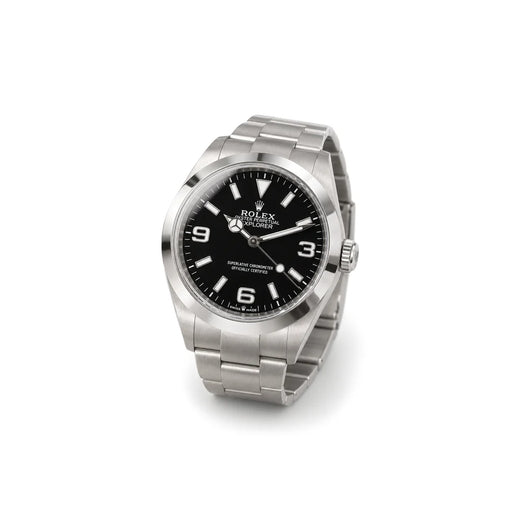
The words OYSTER PERPETUAL describe Rolex's waterproof Oyster case and its self-winding Perpetual rotor, so they appear on the dials of most Rolex models, followed by the model name. The Oyster Perpetual as a model is the one that stops there: no date, no rotating bezel, no chronograph. If your dial reads OYSTER PERPETUAL DATEJUST and shows a date at 3, use our Rolex Datejust real vs fake guide instead. Sports models have their own tells: see our Submariner guide, our GMT-Master II guide and our Daytona guide. To read the format of a serial or find a production window, use the Rolex serial number checker. The plain steel Explorer, with 3, 6 and 9 numerals and no date, is covered in our Rolex Explorer real vs fake guide, and the Land-Dweller, built around an integrated bracelet, in our Rolex Land-Dweller guide.
Why the Oyster Perpetual Is Heavily Counterfeited
The Oyster Perpetual is Rolex's simplest model, and that makes it the easiest Rolex to copy in outline. There is no date wheel to align, no bezel insert to print and no chronograph to fake. A copy that gets the case shape, the colored dial and the bracelet right looks convincing in a listing thumbnail.
Watches are the second largest counterfeit category by value seized in the United States. In the U.S. Customs and Border Protection fiscal year 2024 seizure statistics, seized counterfeit watches were valued at $1,442,665,050 at the manufacturer's suggested retail price, behind only jewelry. The figures are not broken out by brand.
The first checkpoint compares photographs from several confirmed authentic and counterfeit pieces, and I describe what separates them, not a rule for every fake.
The Applied Coronet at 12 O'Clock

On this pair the applied coronet at 12 o'clock is the clearest tell. Scaled to the same height, the genuine coronet's balls are barely wider than its prongs. The counterfeit's balls are about twice the width of its thin, wire-like prongs, so the logo reads as five dots on sticks rather than a solid crown.
- Prongs and balls. The genuine prongs are broad, and each ball is a small cap on its end. The counterfeit prongs are clearly narrower relative to the coronet's height, and the balls are the widest part of each prong. The genuine photo on this card is softer than the copy's, so compare outlines, not sharpness.
- Same pattern in the hero. The pink-dial genuine at the top of this page, a sharper photo, shows the same broad prongs, and so does the genuine with gold hands further down. The blue copy in the hero has thinner prongs with balls about one and a half times their width.
- The indexes prove nothing here. The genuine is an older dial with plain polished batons, the copy imitates a current dial with luminous fill. That is a difference of generation, not a tell.
| Element | Authentic | Counterfeit |
|---|---|---|
| Prongs | Broad | Thin, wire-like |
| Balls against prong width | About the same width | About twice as wide |
| Overall read | A solid crown shape | Five dots on sticks |
Shoot the coronet straight on with a macro lens and crop until it fills the screen. Compare it with Rolex's official image of the same reference cropped to the same height.
Your luxury, verified
Get independent authentication for your luxury items
No Date, No Cyclops: Is It Really an Oyster Perpetual?
The current Oyster Perpetual shows hours, minutes and seconds only, in every size from 28 to 41 mm, under a smooth, domed bezel. A date window at 3 under a magnifying Cyclops lens makes the watch a Datejust or an older Oyster Perpetual Date, and no current Oyster Perpetual has a fluted bezel. A seller who calls a dated watch an Oyster Perpetual has the model wrong, and sometimes the watch as well.
- Dial text. Under the coronet the dial reads ROLEX and OYSTER PERPETUAL with no model name after it, as on both watches in the photo at the top of this page. A Datejust adds the word DATEJUST.
- Reference against size. The steel references are 276200 (28 mm), 277200 (31 mm), 124200 (34 mm), 126000 (36 mm), 124300 (41 mm, 2020 to 2025) and 134300 (41 mm, from 2025). The reference on the papers must belong to the size on your wrist.
- Gold trim exists. Gold hands and indexes appear on genuine Oyster Perpetuals, like the silver-dial genuine further down this page, and in 2026 Rolex added yellow Rolesor versions with a gold bezel, such as the 41 mm ref. 134303 and the 36 mm ref. 126003.
| What to check | What it means |
|---|---|
| Date window or Cyclops lens | Not an Oyster Perpetual model, use the Datejust guide |
| Reference does not match the case size | Papers and watch do not belong together |
| Correct reference, size and dial text | Consistent, not proof |
Measure the case across, without the crown, and set that number beside the reference on the card or listing.
Rehaut Engraving and the Serial at 6 O'Clock
Look at the inner ring between the dial and the crystal, called the rehaut. On a current Oyster Perpetual it is engraved with ROLEX repeated around the ring and the serial number at 6 o'clock. According to Bob's Watches, Rolex began engraving serials there in 2005 and from 2008 engraved them only there. Serials issued since around 2010 to 2011 are random strings that no longer encode a production year.
- Placement and quality. The serial should sit centered on 6 o'clock, with the repeated ROLEX evenly spaced. Under magnification, look for crisp digits of one depth. Off-center, crowded, frosted or uneven characters are a warning.
- Match. The rehaut serial must be the same as the serial on the warranty card, character for character.
- Older watches. A watch made before the change has a plain inner ring, like the older silver-dial genuine on the coronet card above. Its Rolex Oyster Perpetual serial number sits on the case between the lugs at 6.
- What a serial cannot prove. A serial can be copied from a real watch. Our Rolex serial number checker confirms the format and, where the number allows, the era, which tells you whether the number fits the watch, not whether the watch is genuine.
| What to check | What it means |
|---|---|
| No serial on the rehaut of a current watch | Red flag |
| Rehaut serial differs from the card | Papers and watch do not belong together |
| Serial matches and engraving is crisp | Consistent, not proof |
Tilt the watch toward you until 6 o'clock on the rehaut faces the lens, then shoot with the light behind you so the engraving does not flare.
Authenticate Your Items
Handbags, Jewelry, Clothing, Watches, Shoes, Eyewear
Laser-Etched Coronet in the Crystal
Rolex etches a tiny coronet inside the sapphire crystal just above 6 o'clock. Rolex phased it in from around the turn of the century, and it was standard across nearly all models by about 2004. On a genuine watch it is almost invisible to the naked eye and appears as a crown of fine dots under a loupe. A crown you can see easily without magnification is a warning sign.
- How it should look. Bob's Watches describes the genuine etching as made of distinct points set inside the glass, while copies tend to show a thick, frosted line.
- Its limit. Better copies now carry an etched crown of their own, so finding one only removes one reason for doubt.
| What to check | What it means |
|---|---|
| Crown plainly visible at arm's length | Warning sign |
| Solid, frosted outline under the loupe | Warning sign |
| Fine dotted crown that needs light and a loupe | Consistent, not proof |
Against a dark background, rake a bright light across the crystal from the 12 o'clock side and look through a 10x loupe or a phone macro lens. Take several angles.
Caseback, Warranty Card and Serial Match
Turn the watch over. An Oyster Perpetual has a solid caseback with a fluted edge, screwed down against the case, and no display window. Watches sold from 2020 came with a green warranty card that carries a chip and prints the reference, the serial and the date of purchase, and dealers report a redesigned card in 2026. The serial on that card must match the one on the rehaut.
- Card format by year. Before 2020 Rolex issued an older card design, and before 2006 printed paper certificates. Formats overlapped during each change, so judge a card against the date printed on it.
- Guarantee length. Rolex has given a five-year international guarantee since 2015, the year it introduced the Superlative Chronometer certification and its green seal.
- Cards travel separately. Genuine and copied cards are both sold on their own. A card helps only when its reference and serial match the watch.
| What to check | What it means |
|---|---|
| Glass display caseback | Red flag |
| Card serial or reference differs from the watch | Papers and watch do not belong together |
| Card format fits its date and serial matches | Consistent, not proof |
Photograph the card beside the dial in one frame, with the rehaut at 6 in focus, so the two serials can be read together.
Differences That Prove Nothing
Three more photo pairs from this set show differences that look decisive and are not. I include them so they do not mislead you.

- Hands. Both watches carry lumed baton hands. Their tone follows the rest of the dial and proves nothing, and the hubs were shot at different angles.
- Dust under the crystal. The copy's dial carries specks and fibers. That suggests careless assembly, but a genuine watch opened by a careless watchmaker can show the same.

- Lettering and layout. Scaled to the same size, the ROLEX word, its coronet and the title match in proportion and letter shape at this resolution.
- Foil color. Gold on the genuine, silver on the copy here. Foil color shifts with light and camera and is never a tell. Nothing on either cover ties the booklet to one serial, only the warranty card does that.

- Clasp coronet. Both clasp covers carry a coronet. On the copy, faint lines echo the logo's outline and the balls look square, but the whole photo is pixelated, and enlarging a small image creates exactly these halos. How deep a logo looks depends on the light. A clasp comparison means something only when both sides are sharp macros.
Don't guess - know for sure
>99.89% authentication success rate
Red Flags That End the Inspection
One finding ends the inspection on its own: a rehaut serial that does not match the warranty card, or no rehaut serial at all on a watch sold as current. Everything else on an Oyster Perpetual can be copied well, but a mismatch means the watch and its papers did not leave Rolex together.
- A date window, a Cyclops lens or a fluted bezel on a watch sold as a current Oyster Perpetual. Either the listing names the wrong model or the watch is a copy of the wrong one.
- A seconds hand that jumps once per second. The Oyster Perpetual is self-winding and mechanical, so its seconds hand moves in small, quick steps. A once-a-second tick means quartz.
- A glass display caseback. The Oyster Perpetual has a solid caseback.
- A crystal crown you can see without a loupe. The genuine etching hides until light and magnification find it.
- A dial coronet of thin prongs and large balls. On the pairs in this guide that shape belongs to the copies. Treat it as a reason to check everything else, not a verdict alone.
Not red flags on their own: dial color, the tone of the hands, the shine of the steel, booklet foil color, and a serial that decodes correctly.
What Current Superfakes Get Right
The copies in these photos reproduce the case shape, the smooth bezel, the dial text, applied indexes, the bracelet and the booklet. The copy on the coronet card above even carries an engraved rehaut, and better copies add an etched crystal crown, as Bob's Watches and Luxury Bazaar both warn. Neither check clears a watch on its own anymore.
What these Oyster Perpetual copies still miss is the shape of one small applied part. On the copies in this guide the dial coronet has the wrong proportions, thin prongs under oversized balls. A shape like this is hard to match without the original tooling, so it is worth checking even when the obvious details pass.
The 2025 update adds one more check for the 41. According to Bob's Watches, the ref. 134300 has a larger Twinlock crown, thinner lugs and a slimmer clasp than the 124300, with lug-to-lug length down from 47.5 mm to 46 mm. A watch sold as a 134300 should show those proportions next to Rolex's official photos.
What You Can Check Yourself and What You Cannot
The model checks transfer best through a written guide: no date, the right reference for the size, a serial on the rehaut that matches the card, a solid caseback. Each has a fixed answer. The coronet shapes, the engraving quality and the crystal etching are harder, because they are judgments about how a part was made, and they need a confirmed watch of the same reference to compare against.
Older Oyster Perpetual references use different dials, hands and indexes, so a detail that differs from the watches shown here is not automatically fake. Only a watchmaker who opens the case can compare the movement, and Rolex service centers remain the final word.
When we review an Oyster Perpetual from customer photographs at LegitGrails, at least two specialists compare the coronets, the rehaut and the papers against confirmed watches of the same reference. You can authenticate your Rolex Oyster Perpetual with our experts before you pay a seller.
Get 20% Off Your First Authentication
Free authentication guides and expert tips
No spam. Unsubscribe anytime. Privacy Policy
Frequently Asked Questions
How to tell if a Rolex Oyster Perpetual is real?
Confirm the model first: no date, no Cyclops, a smooth domed bezel and a reference that fits the case size. Then compare the applied coronet at 12 with Rolex's photo of the same reference, read the serial on the rehaut at 6 and match it to the warranty card, and look for the etched crown inside the crystal under a loupe. No single check is enough.
Rolex Oyster Perpetual original vs fake: what should I check?
On the pairs in this guide, the original's dial coronet has broad prongs with small balls, the fakes thin prongs with oversized balls. Then confirm the model, check the rehaut serial against the warranty card, look for the fine etched crown in the crystal under a loupe and make sure the caseback is solid. No single check settles it.
How do you authenticate a Rolex Oyster Perpetual?
How to authenticate a Rolex Oyster Perpetual from photos: shoot the dial straight on and the coronet at 12 in macro. Add the rehaut at 6, the clasp cover, the caseback and the warranty card beside the dial, then compare each with Rolex's official images of the same reference. Our experts can review those photos. Only a watchmaker or Rolex service center can examine the movement.
Where is the serial number on a Rolex Oyster Perpetual?
On a current watch the Rolex Oyster Perpetual serial number is engraved on the rehaut, the inner ring between dial and crystal, at 6 o'clock. Rolex began engraving it there around 2005 and by about 2008 engraved it only there. Older watches carry it on the case between the lugs at 6, under the bracelet. The same serial is printed on the warranty card.
Is every Rolex with "Oyster Perpetual" on the dial an Oyster Perpetual model?
No. OYSTER PERPETUAL names the waterproof Oyster case and the self-winding Perpetual rotor, so most Rolex dials carry it, followed by the model name, such as DATEJUST. The Oyster Perpetual model is the one whose dial stops at OYSTER PERPETUAL, with no date and no rotating bezel.
Does a real Oyster Perpetual have a date?
No current Oyster Perpetual has a date. Every size from 28 to 41 mm shows hours, minutes and seconds only. A watch with a date window at 3 and a Cyclops lens is a Datejust or an older Oyster Perpetual Date, so judge it against that model, not this one.
What do fake Oyster Perpetual dials get wrong?
On the fakes in this guide, the dial printing and layout are close, and the mistake is in the applied coronet at 12: thin, wire-like prongs carrying balls up to about twice their width. One copy also shows dust and fibers under the crystal. Color and index style are not tells, because genuine dials vary by reference and year.
How long does a Rolex Oyster Perpetual run when fully wound?
About 70 hours for the 36 and 41 on calibre 3230, and about 55 hours for the 28, 31 and 34 on calibre 2232. Every size is waterproof to 100 metres. A fully wound watch that stops overnight needs a watchmaker's check.