 2 Methods
February 2026 · 6 min read
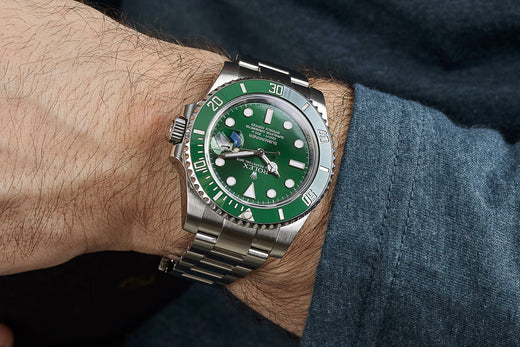
Rolex Hulk Fake vs. Real: How to Spot the ...
7 minutes read.
Enter the serial exactly as engraved, letter first if there is one.
A Rolex serial dates the watch, approximately. Numbers ran in sequence from 1926 to mid-1987, then letter prefixes covering one or two years each until 2010, and from 2011 the serials are randomised and carry no date at all. Rolex restarted numbering from a low number in 1954, so a six-digit serial can belong to two different decades and this checker returns both.
A serial places a watch in a year or two, if the serial is genuine. It proves nothing on its own. Rolex has never published these charts: they are reconstructions from observed watches, so every answer here is approximate. What actually settles a Rolex is the movement, the dial printing and the case finishing, none of which can be read from a number.
| Era | What the marking looks like | Example |
|---|---|---|
| 1987 to 2010, a letter then digits | One letter then six or seven digits | R123456 → 1987 to 1988 |
| 1954 to 1987, the second numbering run | Four to seven digits, no letter | 5100000 → 1977 to 1978 |
| 1926 to 1953, the first numbering run | Four to six digits, no letter | 302459 → 1945 |
| 2011 onwards, randomised | Eight mixed letters and digits | 7A8B9C0D |
Compiled from professional authentication references and reviewed in-house.
| Serial range | Year |
|---|---|
| 1950s | |
| 23,000 to 96,999 | 1954 |
| 97,000 to 133,060 | 1955 |
| 133,061 to 223,999 | 1956 |
| 224,000 to 327,999 | 1957 |
| 328,000 to 399,452 | 1958 |
| 399,453 to 515,999 | 1959 |
| 1960s | |
| 516,000 to 643,152 | 1960 |
| 643,153 to 743,999 | 1961 |
| 744,000 to 823,999 | 1962 |
| 824,000 to 1,008,888 | 1963 |
| 1,008,889 to 1,099,999 | 1964 |
| 1,100,000 to 1,199,999 | 1965 |
| 1,200,000 to 1,538,434 | 1966 |
| 1,538,435 to 1,751,999 | 1967 |
| 1,752,000 to 1,899,999 | 1968 |
| 1,900,000 to 2,241,881 | 1969 |
| 1970s | |
| 2,241,882 to 2,589,294 | 1970 |
| 2,589,295 to 2,890,458 | 1971 |
| 2,890,459 to 3,200,267 | 1972 |
| 3,200,268 to 3,567,926 | 1973 |
| 3,567,927 to 3,862,195 | 1974 |
| 3,862,196 to 4,115,298 | 1975 |
| 4,115,299 to 4,999,999 | 1976 |
| 5,000,000 to 5,737,029 | 1977 to 1978 |
| 5,737,030 to 6,433,999 | 1979 |
| 1980s | |
| 6,434,000 to 6,520,869 | 1980 |
| 6,520,870 to 7,099,999 | 1981 |
| 7,100,000 to 7,399,999 | 1982 |
| 7,400,000 to 8,070,021 | 1983 |
| 8,070,022 to 8,613,999 | 1984 |
| 8,614,000 to 8,899,999 | 1985 |
| 8,900,000 to 9,399,999 | 1986 |
| 9,400,000 to 9,999,999 | 1987 |
| 1920s | |
| 1 to 20,189 | 1926 |
| 20,190 to 29,131 | 1927 to 1930 |
| 1930s | |
| 29,132 to 29,561 | 1931 to 1932 |
| 29,562 to 30,822 | 1933 |
| 30,823 to 34,335 | 1934 |
| 34,336 to 36,855 | 1935 |
| 36,856 to 40,919 | 1936 |
| 40,920 to 43,738 | 1937 |
| 43,739 to 71,223 | 1938 |
| 71,224 to 99,774 | 1939 |
| 1940s | |
| 99,775 to 106,046 | 1940 |
| 106,047 to 143,508 | 1941 |
| 143,509 to 230,877 | 1942 |
| 230,878 to 269,560 | 1943 |
| 269,561 to 302,458 | 1944 |
| 302,459 to 367,945 | 1945 |
| 367,946 to 529,162 | 1946 |
| 529,163 to 628,839 | 1947 |
| 628,840 to 709,248 | 1948 |
| 709,249 to 726,638 | 1949 to 1951 |
| 1950s | |
| 726,639 to 855,725 | 1952 |
| 855,726 to 999,999 | 1953 |
Rolex restarted its numbering from a low number in 1954, so a six-digit serial can belong to two completely different decades. The checker returns both rather than picking one. The published year charts are also reconstructions from observed watches, not something Rolex publishes, so treat every answer as approximate. The one dealer page that publishes a margin puts it at one to two years, and a second explains why there cannot be a firm one: the prefixes changed mid-year and the ranges overlapped. The published charts also contradict themselves in a few places, listing a later year with a lower serial. Those spans are returned as windows rather than resolved to a year.
The reference number is not the serial. It identifies the model, and it carries no production date. Rolex has never published a key to it: the structure below is trade convention, reconstructed by dealers from the watches they handle, and the pages that publish it say as much themselves. Read it alongside the serial rather than instead of it.
| Part of the reference | What the trade reads it as |
|---|---|
| The leading digits | The model family. The dealer guides describe the first digits as the model and none of them publishes a complete family key, so this page does not either. |
| The penultimate digit | The bezel type. |
| The last digit | The metal of the case and bracelet: 0 steel, 1 steel with Everose gold, 2 steel with platinum, 3 steel with yellow gold, 4 steel with white gold, 5 Everose gold, 6 platinum, 8 yellow gold, 9 white gold. |
| Letters after the digits | A dial or bezel colour suffix, taken from French: LN for a black bezel, LV for a green one, LB for a blue one. This is the least corroborated part of the system, and it rests on one enthusiast page plus one dealer glossary. |
On watches up to the mid 2000s, it is engraved between the lugs on the 6 o'clock side of the case, under the bracelet, so the bracelet has to be moved to read it. From about 2005 the serial was also engraved on the rehaut, the inner flange between the dial and the crystal, at 6 o'clock, and from about 2008 the rehaut is the only place it appears, a change one dealer describes as phased in across 2008 to 2010 rather than made on a single day. The reference number is engraved between the lugs on the other side, at 12 o'clock, and it is a different number.
The rehaut also carries the word ROLEX repeated around it with a crown at 12 o'clock, so the serial sits in the gap at the bottom. The earliest engraved rehauts date to 2004, they became usual in 2005, and by 2008 every Oyster reference carried one. Sources put the start anywhere from 2004 to 2007 depending on the model line, so 2005 is the middle of a phase-in rather than a switch. From 2011 the serial is randomised, and once the number gives no year the warranty card or the original invoice is what dates the watch. A card that matches the watch is a good sign rather than proof: it confirms the paper and the watch agree with each other, nothing more.

From 2011 every Rolex serial is randomised, and the changeover ran through 2010, so a modern watch has no date in its number and no chart can supply one. Look on the rehaut, the inner flange between the dial and the crystal at 6 o'clock, which is where the serial moved to. On older watches it is engraved between the lugs under the bracelet, so the bracelet has to come off to read it.
The things people actually ask us about Rolex serial numbers, answered by the team that reads them for a living.
On older watches, engraved between the lugs at the 6 o'clock side, under the bracelet, so the bracelet has to be moved to read it. From around 2005 it also appears on the rehaut, the inner flange between the dial and the crystal. The first engraved rehauts date to 2004, every Oyster reference had one by 2008, and from about 2008 the rehaut is the only place it appears. The rehaut carries the word ROLEX repeated around it with a crown at the top, and the serial sits in the gap at 6 o'clock. The number between the lugs on the other side, at 12 o'clock, is the reference rather than the serial.
Because Rolex restarted its numbering from about 23,000 in 1954. A six-digit serial can therefore belong to the 1926 to 1953 run or the 1954 to 1987 one. The number alone genuinely cannot separate them, so this checker returns both rather than picking.
It is from 1987 to 2010. The letters were issued in sequence and the published charts anchor each one to a starting serial, so most cover a single year and the rest cover two. Where a prefix spans two years you get the window rather than a guess inside it: R is 1987 to 1988, and nothing in the number itself separates the two. The model, the papers and the case finishing are what narrow it.
Rolex randomised its serials completely. Three dealer charts show the last dated prefix, G, running to 2010 and every year from 2011 as random. Their prose differs on when it happened, one saying mid-2011 and another around late 2010, but none of the tables runs a letter into 2011, so 2010 is the last lettered year. There is no date encoded in a randomised serial, and any tool that returns a year for a modern Rolex serial is guessing.
Approximate, and deliberately presented that way. Rolex has never published a serial-to-year chart, so every chart in circulation, including the ones behind this page, is reconstructed from observed watches. The one dealer page that states a margin puts it at a one to two year range, and gives the reason: cases and movements were stockpiled and assembled later, so even a correct reading dates the part rather than the finished watch. A second dealer gives the same answer without a number: the prefixes changed mid-year and the ranges overlapped, so the published dates are guidelines and not calendar facts. No source we could find says whether the charts date the case or the movement, and this page does not guess.
Possibly neither, exactly. The published charts even contradict themselves in places, most visibly around 1977 and 1978, which is why this checker returns a window across that span instead of choosing.
No. Serials are engraved on counterfeits too, and a correct-looking number on the wrong movement is a common combination. Dealers who authenticate for a living report the same number being reused across many different fakes, so a serial that looks right is not even evidence that it is unique to your watch. Matching papers are not proof either. A Rolex card prints the dealer, the purchase date, the country code, the buyer, the model and the serial, and all a match tells you is that the card and the watch agree with each other, not that either is genuine. The movement, the dial printing and the case finishing decide it.
Just the year, approximately. The model lives in the reference number, engraved between the lugs at 12 o'clock, which identifies the family, the bezel and the metal rather than the age. How a reference is put together is set out above, and it is trade convention rather than anything Rolex publishes. For a check what matters is that the serial, the reference, the movement and the case all agree with each other.
A code narrows things down. These guides cover what it cannot tell you about a real Rolex: the movement, the dial printing and the case finishing. Anton K., our guide author since 2019, draws every method from what our authenticators have documented across 2 million+ real items. Read his Rolex guides, or browse the full library of free guides covering 100+ luxury brands.
2 Methods
7 minutes read.
 8 Methods
6 minute read.
 7 Methods
 7 Methods
 13 Methods
8 minute read.
Get expert authentication
>99.89% accuracy · 2M+ verified