 4 Methods
July 2024
· 5 min read
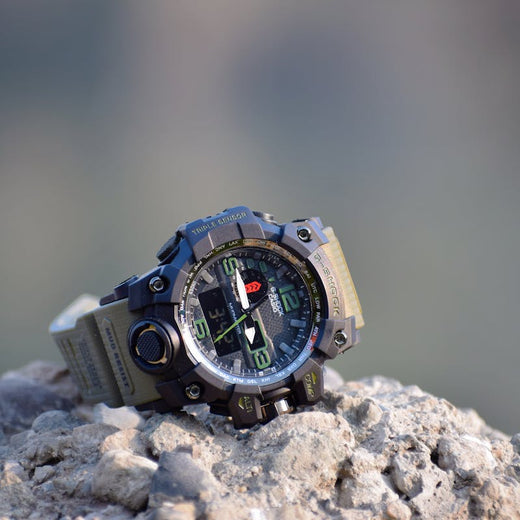
How To Spot Real Vs Fake G-Shock Watch
5 minute read.
Type the model name from the caseback, the box or the tag, such as GW-M5610U-1, or the G-Shock module number, the four digits framed on the caseback, such as 3229.
A G-Shock carries two numbers that matter. The model name, such as GW-M5610U-1, is engraved on the caseback in a shortened form and printed in full on the box and the tag. Its letters and digits follow a pattern collectors have mapped: a series prefix such as GW, a function letter such as B for Bluetooth, the series number, version letters, and a digit that usually stands for a main color. Casio publishes no key to that pattern, so this G-Shock model number checker reads only the parts two independent sources agree on and says so where it is a collector reading. The module number, four digits usually framed on the caseback beside the model name, names the movement inside. Casio files its manuals by that number, so the checker links you straight to Casio's own manual for it. None of this is a date, and none of it can tell you whether a watch is genuine.
It tells you whether a model name is built the way G-Shock model names are built, what each part usually means, and which Casio manual belongs to a module number. That is a floor, not a verdict. A well-formed model name does not prove the watch is genuine, because counterfeit casebacks copy real model and module numbers from Casio's own pages. What deserves attention is disagreement: a caseback whose module number opens a manual for a very different watch, a model name that says Bluetooth or solar on a watch with neither, or a model name on the caseback that does not match the box and the tag. Any of those is worth a closer look, though not proof on its own. One model can also carry more than one genuine module over the years, so a different module from the one a seller lists is not a fault by itself.
| Era | What the marking looks like | Example |
|---|---|---|
| G-Shock model name | Series prefix, function letter, series number and version letters, then a color digit and market code | GW-M5610-1ER |
| Casio module number | Four digits, usually framed on the caseback | 3229 |
Compiled in-house from Casio's own manual, support and product pages and from collector references that agree with them.
A G-Shock model name such as GMW-B5000D-1ER is built from parts. The series prefix, such as GW, DW or GA, comes first, then a function letter such as B for Bluetooth where there is one, then the series number, then version letters. After the hyphen come a color digit, sometimes a variant letter and an accent digit, and on the box a market code. Casio publishes no key to these parts, so the table below gives only the readings that two independent sources agree on, and marks the color digits as a collector reading. The module number, four digits on the caseback, is a separate number: it names the movement and opens Casio's manual. None of it is a date and none of it is unique to your watch.
| Part | In 3459 GMW-B5000D-1ER | What it means |
|---|---|---|
| Module number | 3459 | The movement inside. Opens Casio's own manual |
| Series prefix | GMW | Full metal: a metal case and bezel rather than resin |
| Function letter | B | Bluetooth, the link to Casio's phone app |
| Series number | 5000 | The square 5000 case |
| Version letters | D | A stainless steel bracelet. T is titanium, L leather. Other letters, such as E or U, have no published meaning |
| Color digit | 1 | Usually black, a collector reading Casio does not publish |
| Variant letter and accent digit | none here | A, B or C tell variants within a color apart, a digit after them the color of the hands or display, and V an export version |
| Market code | ER | Europe. JF is Japan, JR a Japan limited release, DR export |
| Prefix or letter | Usually means |
|---|---|
| DW | Digital, battery powered |
| G | Simply G-Shock |
| GA | Analog hands with a digital display |
| GW | Waveceptor: Tough Solar, Multi Band, or both |
| GM | Metal Covered bezel over resin |
| GMW | Full metal |
| GD | Digital |
| GL, GLX | G-Lide surf line |
| GBD, GBA, GBX | Bluetooth (the B) |
| GPR | GPS Rangeman line |
| GWF | Usually the Frogman diver line |
| MTG | MT-G, Metal Twisted G |
| MRG | MR-G line |
| B before the number | Bluetooth |
| M before the number | On GW models, usually Multi Band |
| S before the number | A smaller case |
| H before the number | A heart rate sensor |
| Model | Module number |
|---|---|
| DW-5600E | 3229 (3525 on the 2023 DW-5600UE) |
| DW-6900 | 3230 (3529 on the 2023 DW-6900U) |
| GW-M5610 | 3159 |
| GW-M5610U | 3495 |
| GA-2100 | 5611 |
| GA-B2100 | 5689 |
| GW-B5600 | 3461 |
| GMW-B5000 | 3459 (3539 on later models) |
| GA-100 | 5081 |
| GW-9400 Rangeman | 3410 |
On the caseback. The model name is engraved there, usually shortened to the series part such as GW-M5610U, and the four digit module number sits beside it, usually in a small frame to its left or above it. The full model name with the color digit and market code is printed on the box and the tag.
Casio says the model number is marked on the back cover. Collector guides place the module number in a box or frame beside it, but no source says every model frames it, so compare your caseback with the box, the tag and Casio's manual rather than expecting one exact layout.
Several ordinary reasons, none of them a sign of a fake. The checker reads G-Shock, MT-G and MR-G model names, and Casio's other lines, such as Baby-G, Pro Trek, Edifice or the standard digital watches, use names it does not read. It reads one number at a time: a model name, or a four digit module number, or both with the module first, as in 3229 DW-5600E. Leave off the other words on the caseback, such as SHOCK RESIST, the water rating and the country. On Tough Solar models the caseback also carries a short code of digits and letters, such as 202A 246 E. That is neither the model nor the module, and the checker does not read it. Engravings wear, so the letter O and zero, or the letter I and one, are easy to mix up. And a prefix or letter we do not list is shown as not in our list, which is not a fault: Casio publishes no key, and we read only what two sources agree on.
The things people ask about G-Shock model numbers, answered from the sources this page is built on.
On the caseback. Casio's own support page says the model number is marked on the back cover of the watch, as letters and numbers joined by a hyphen. The caseback usually shows only the series part, such as GW-M5610U or DW-5600E, and the box and the tag print the full name with the color digit, such as GW-M5610U-1. The four digit number beside it on the caseback, usually in a small frame, is the module number.
It is the number of the movement inside the watch, four digits such as 3229 or 5611, usually engraved in a small frame on the caseback to the left of or above the model name. Casio files its instruction manuals by this number, which is why the checker sends you to Casio's own manual for it. The tag and the manual carry it too.
Casio does not publish a key, and collectors say the naming is not fully consistent. The parts that two independent sources agree on are these. DW is a digital, battery powered model. GW is Waveceptor: Tough Solar, Multi Band radio time sync, or both. GM is Metal Covered, a metal bezel over resin, and GMW is full metal. A B before the number means Bluetooth, an S a smaller case, and an M on GW models usually Multi Band. After the number, D, T and L mean a steel bracelet, a titanium bracelet and a leather strap. Other letters, such as E or U, have no published meaning.
Collectors read the first digit after the hyphen as the main color: 1 usually black, 2 blue, 3 green, 4 red, 5 brown, 6 purple, 7 white, 8 gray and 9 yellow or gold. A letter after it, such as A or B, tells variants within that color apart, and a second digit, as in GA-2100-1A1, the color of the hands or the display. This is a collector convention, not a Casio key, so the checker says usually, and Casio's page for your model is the place to confirm the color.
They are market codes printed on the box and the tag, not on the caseback. Collectors read ER as Europe, JF as Japan, JR as a Japan limited release and DR as export to regions without a Casio distributor. A lone V, as in DW-5600E-1V, is read as an export version. Collectors disagree on some other codes, such as CR, so the checker leaves those unread. A market code says where a watch was meant to be sold, not where it was made.
Not a G-Shock serial number Casio publishes a meaning for. The model name and the module number are shared by every watch of that model. Tough Solar models also carry a short code on the caseback, such as 202A 246 E, which collectors read as a factory, a day of the year and a year letter. Casio has not published that reading, and the year letter repeats every ten years, so the checker does not read it and the page does not date watches from it.
Not from the model name or the module number. Neither carries a date. The module number can narrow the period a little, because Casio sometimes moves a model to a new module, as when the GW-M5610 moved from module 3159 to 3495 in 2021 and the GW-M5610U name followed. That tells you which version you have, not the year it was made.
Not by itself. One model can carry more than one genuine module over the years: the DW-5600 has used 3229 and later 3525, and in the United States the updated square solar model was sold under the older name for a while. Open Casio's manual for the number on your caseback and check that it describes a watch like yours, with the same functions, buttons and display.
No. Both are printed on Casio's own pages and copied onto counterfeit casebacks, so a well-formed number proves nothing. Collectors point to other things that fakes get wrong: a caseback that bulges, shallow or blurry engraving, and a missing module number. Those are reasons to look closer, not proof either way.
Casio offers no public lookup that confirms a watch is genuine from its numbers. Its advice, in a statement on counterfeits, is to buy only from authorized retailers. What Casio does publish is the manual for each module, which is what the checker links to.
A code narrows things down. These guides cover what it cannot: the stitching, the hardware and the leather, brand by brand. Anton K., our guide author since 2019, draws every method from what our authenticators have documented across 2 million+ real items. Browse the full library of free guides covering 100+ luxury brands.
4 Methods
5 minute read.
 10 Methods
7 minutes read.
 6 Methods
5 minute read.
 7 Methods
5 minute read.
 7 Methods
7 minute read.
 11 Methods
 2 Methods
7 minute read.
Get expert authentication
>99.89% accuracy · 2M+ verified