Cartier Santos Real vs. Fake: How to Spot the Differences

Last Updated on:
The Cartier Santos watch, introduced in 1904, remains a timeless icon in horology, revered for its refined design and pioneering legacy. However, its prestige has made it a prime target for counterfeiters, leading to an influx of increasingly sophisticated fake models. The rise of high-quality replicas presents a serious challenge for buyers seeking an authentic timepiece.
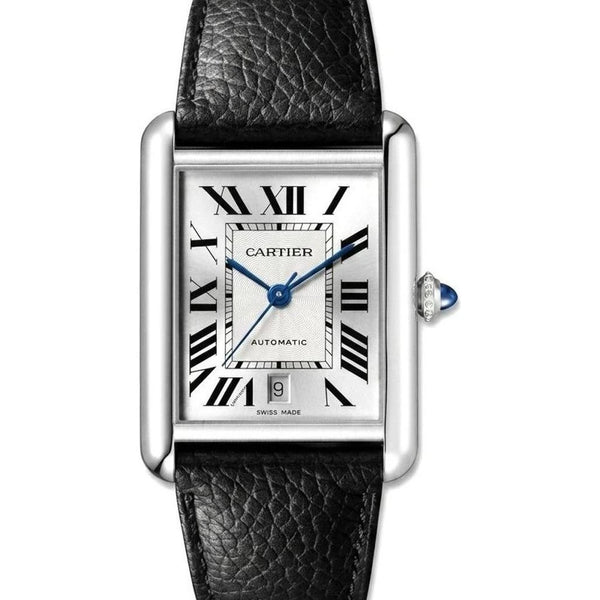
A key hallmark of authenticity is the signature blue cabochon set into the crown. Genuine Cartier Santos watches showcase a deep, high-quality blue spinel or sapphire cabochon with a striking luster. In contrast, counterfeit versions often feature low-grade painted glass or plastic, resulting in a dull, lackluster appearance that fails to capture the brilliance of a true Cartier cabochon.
Table of Contents
[ open ]What to Check: Real vs. Fake
Don’t know where to start the authentication process? Here’s some tips!
Case & Screws
The case and screws of a Cartier watch offer crucial clues to its authenticity. Genuine Cartier timepieces are renowned for their exceptional craftsmanship and meticulous attention to detail. Their cases are precisely machined from premium materials, ensuring a flawless, polished finish that reflects the brand’s commitment to excellence. Authentic Cartier Santos models feature high-quality stainless steel, yellow gold, or a combination of both, with a signature square case, Roman numerals, and visible bezel screws that are evenly spaced, deeply embedded, and feature a uniform flathead design.
One of the most telling signs of an authentic Cartier watch is the precise alignment and uniformity of its screws. Cartier ensures each screw is perfectly positioned and tightened, creating a balanced and harmonious aesthetic. The screws should sit flush with the surface of the case, with no gaps, irregular spacing, or protrusions.
In contrast, counterfeit Cartier watches often feature poorly finished or misaligned screws. They may be unevenly spaced, vary in size, or fail to sit flush with the case. Some fakes even use non-functional decorative screws. Additionally, counterfeit cases tend to have a rough or matte finish, lacking the refined, luxurious shine of an authentic Cartier watch.

Weight of the Watch
An authentic Cartier Santos has a noticeable weight, a testament to its solid construction and premium materials. In contrast, counterfeit versions often feel significantly lighter due to the use of cheaper metal alloys or hollow components. If you were to compare an authentic Santos with a fake side by side, the genuine piece would have a more substantial heft, reflecting its superior craftsmanship and durability.

Case Back Engraving & Serial Number
The case back of an authentic Cartier Santos is distinguished by its precise, deeply engraved, and impeccably clean markings with sharp, clear fonts. It typically includes the Cartier logo, the words “Water Resistant” and “Swiss Made,” along with a unique serial number.
On a pre-2009 watch the first two digits of the serial are the year. Our free Cartier serial number checker reads it, and tells you plainly when a serial is one of the randomised later ones that carries no date at all.
In contrast, counterfeit versions often feature shallow, uneven, or misaligned engravings, with serial numbers that are poorly stamped, repeated across multiple fakes, or entirely inaccurate. For instance, a fake watch might have a lightly etched serial number that lacks the depth and crisp definition of genuine Cartier engravings.

Dial & Logo Accuracy
The dial of an authentic Cartier Santos is impeccably printed, with sharp, well-spaced Roman numerals and a precise, clearly engraved Cartier name, typically positioned below the 12 o’clock mark. Counterfeit versions often reveal themselves through slightly misaligned or uneven numerals and a blurred or faded “Cartier” logo.
Another key authenticity marker is the brand’s secret signature – on genuine models, the word “Cartier” is subtly embedded within the arm of the Roman numeral VII at 7 o’clock or X at 10 o’clock. Many counterfeits omit this intricate detail, making it a crucial feature to check.

Scratch-Proof Sapphire Glass
Genuine Cartier Santos watches feature scratch-resistant sapphire crystal, known for its exceptional clarity and high reflectivity under light.
In contrast, counterfeit models often use lower-quality mineral glass or plastic, which can appear dull or show distortions when viewed from different angles.
A simple way to test authenticity is by lightly scratching the surface – real sapphire crystal is highly resistant to scratches, while fakes may show visible marks.

Signature Blue Cabochon
The crown of an authentic Cartier Santos is set with a deep-blue spinel or sapphire cabochon, showcasing a rich, natural luster. Counterfeit versions often feature cabochons that are either too dark, too light, or lack vibrancy.
If the blue stone appears painted on, overly glossy, or plastic-like, it’s a strong indicator of a fake. Additionally, the cabochon on a genuine piece is securely set, while fakes may have a glued-on stone that can loosen over time.

Cost & Too-Good-To-Be-True Pricing
Genuine Cartier Santos watches typically retail between $7,000 and over $50,000, depending on the model.
If you come across one priced under $3,000, it’s almost certainly a counterfeit. Scammers frequently advertise “unbelievable deals” on unreliable marketplaces, so always verify authenticity before making a purchase.
Conclusion
Distinguishing a genuine Cartier Santos from a counterfeit requires a close inspection of key details, including the signature blue cabochon, case and screws, weight, case back engravings, dial precision, and sapphire crystal quality. To avoid purchasing a fake, always buy from reputable retailers or verify authenticity before committing to a purchase.
For expert authentication with a high accuracy rate, consider using LegitGrails’ professional services. Visit LegitGrails.com to have your Cartier watch authenticated by specialists, ensuring confidence in your investment.
Related Posts

How to Tell a Fake vs. Real Cartier Watch
7 minute read.

How to Tell if Cartier Glasses Are Real
7 minute read.

How to Spot a Real vs. Fake Cartier Bracelet
6 minute read.

How To Spot Fake Cartier Juste Un Clou Bracelet
6 minute read.

How To Spot Fake Cartier Love Ring
7 minute read.


