How to Tell If Golden Goose Ball Star Is Real
Golden Goose Ball Star fakes are most often caught by the oversized star application, the GG/DB insole perforation pattern, and the heel tag GOOSE ligature, in that order. To authenticate one yourself in 2026, examine the side star for sewn-and-glued construction with pair-to-pair placement variance, verify the left insole perforations spell "GG" and the right spell "DB" with a transparent right-foot label, and check the heel tag for a connected "GO" ligature in GOOSE. The ten checkpoints below are what a written guide can transfer. Professional authenticators read dozens of finer signals across hand-distressing variance, sole rubber compound, and contrast-leather quality that take years of side-by-side reference work to read fluently from a photo.
The Golden Goose Ball Star (a low-top sneaker inspired by 1980s American college basketball footwear, in continuous production since the late 2000s) retails at $595 to $1,330 USD on goldengoose.com US (with classic leather variants typically $595 to $695) and the equivalent in euros for European storefronts. Secondary-market authentic pairs sit between $300 and $450 on platforms like StockX and Vestiaire Collective. That price band is exactly why counterfeit production scales here. Golden Goose appears repeatedly in U.S. Customs and Border Protection enforcement releases as a frequently seized counterfeit sneaker brand, alongside Nike, Adidas, and luxury fashion houses.
| Checkpoint | What to Inspect | Reliability |
|---|---|---|
| Oversized Star Application | Sewn AND glued, edges precise, placement randomized pair-to-pair | ★★★★★ |
| Insole GG/DB Perforation | Left insole spells "GG", right insole spells "DB", transparent right-foot label | ★★★★★ |
| Heel Tag GOOSE Ligature | "GO" letters connected as a single ligature, uniform emboss depth, all uppercase | ★★★★★ |
| Hand-Distressing Pattern | Unique per pair, no two pairs identical, dirt streaks asymmetric left to right | ★★★★★ |
| Box Label and Silver Foil | Model code in correct font, "Made in Italy", silver foil lifts under fingernail | ★★★★ |
| Sole Wave Pattern | Standardized wave tread, straight lines, ~2.5cm rubber thickness, dense feel | ★★★★ |
| Stitching Density and Tension | Even stitch spacing, color matched to leather, no skipped passes inside the upper | ★★★★ |
| Glue Lines at Midsole | Clean joint at upper-to-sole bond, no globs, no yellowing residue | ★★★ |
| Leather Grain and Suede | Real cracking with depth variation on calfskin, dense nap on suede variants | ★★★ |
| Dust Bag and Authenticity Card | GGDB rose-gold foil (not yellow-gold), dense weave, lace aglet detail intact | ★★★ |
How the Ball Star Differs from Super Star, Hi Star, and Mid Star
The Ball Star is a low-top sneaker with basketball heritage, distinguished by an oversized side star application that sits larger than the star on the Super Star and runs from the midsole well up onto the upper panel. Where the iconic Super Star authentication guide covers the classic low-top silhouette with a smaller proportionally placed star, the Ball Star carries a flatter toe profile, a slightly lower-cut collar, and a vintage college-court reference in the panel construction. Counterfeit listings routinely confuse Ball Star with Super Star because both are low-tops, but the star size and proportion are the immediate giveaway. Cross-reference our Hi Star authentication guide for the high-top variant with leather collar and platform sole, and the Mid Star authentication guide for the mid-cut perforated leather sibling.
The Basketball and Skate Heritage Behind the Ball Star
The Golden Goose Ball Star is Golden Goose's tribute to 1980s American college basketball footwear, in continuous production since the late 2000s and built on a skateboarding influence the brand calls out explicitly. The silhouette references the canvas and leather low-tops worn on college courts in that era, the oversized side star nods to the era's varsity graphics, and the asymmetric hand-distressing (right shoe more worn than left) references how skateboarders use their right foot to push off the ground. None of this matters for authentication on its own, but it matters for context. When counterfeit listings describe Ball Star as a 'classic retro low-top' without any of these specifics, they are usually working from a generic Golden Goose template, not a Ball Star reference set. The model-specific construction details below all trace back to this heritage, the panel construction, the flatter toe profile, the oversized star proportions, and the right-shoe distressing asymmetry. Authentication that ignores the model story misses the diagnostic details the story produces, which is why our authenticators read brand heritage as a context layer above the visual checks.
Ball Star Variant Reference
Counterfeit listings frequently mislabel Ball Star sub-variants. The authentication techniques in this guide apply across every Ball Star release. The primary commercial variants in current circulation:
| Variant | Notes |
|---|---|
| Ball Star Classic White Leather | Calfskin upper, contrast-color star (red, blue, green), metallic heel tab |
| Ball Star Suede | Suede upper, often pastel or earth tones, suede star matching or contrasting |
| Ball Star Glitter | Glitter heel tab, glitter star, primarily women's line |
| Ball Star Pro | Updated proportions, cleaner distressing, retail-only positioning |
The Brand Behind the Ball Star
Golden Goose was founded in Venice in 2000 by designers Alessandro Gallo and Francesca Rinaldo, originally as a women's footwear and accessories label rooted in the Veneto craftsmanship tradition. The brand moved its headquarters to Marghera near Venice as it grew, and now produces every authentic pair in Italy with hand-distressed finishing applied pair by pair. Ownership has cycled, Carlyle in 2017, Permira in 2020, and Chinese investment firm HSG agreeing to acquire the brand at a roughly €2.5 billion valuation in December 2025, but the Marghera production base and the hand-distressed finishing process have stayed put under each owner. Ball Star sits in Golden Goose's basketball-heritage lineage as a low-top, with an oversized side star that wraps further toward the toe and a wider toe-box than the Super Star. Authenticity hinges on construction details counterfeit factories cannot replicate at scale, which is why the ten checkpoints below focus on hand-application variance, leather grain, and the GG and DB insole perforation pattern rather than any single visible logo or stamp.
If You Only Have 2 Minutes to Tell If Your Golden Goose Ball Star Is Real
Three of the ten signals in this guide carry the most weight. A failure on any one of them is enough to call the pair counterfeit before running the rest of the checklist.
- The G-O ligature on the heel tab. Authentic Ball Star carries a small leather heel tab printed with "G O" where the G and O are joined by a hidden ligature stroke. Counterfeit production either prints the G and O as two clearly separated letters or overshoots the gap between them. This is the single most consistent brand-level signal on the Ball Star.
- The GG and DB perforations on the underside of the insole. Pull the insole out, the underside should reveal two perforation patterns that resolve as readable GG (at the heel position) and DB (at the toe position) when held against light. Counterfeit insoles either misalign the patterns or substitute laser engraving that fails to read as letters.
- Right-shoe-heavier hand-distressing. Authentic Ball Star pairs consistently show heavier hand-distressing on the right shoe than the left, a finishing pattern that traces back to the brand's skateboarding-inspired design language. Mirror-symmetric distressing across both shoes, or a left shoe heavier than the right, is a counterfeit signal specific to the Ball Star.
If all three checks pass, the remaining seven (oversized star application, box label, sole pattern, stitching, glue lines, leather grain, dust bag) confirm the pair is not a top-tier counterfeit that has cloned the high-weight signals. The detailed breakdown follows below.
Why Is the Golden Goose Ball Star So Heavily Counterfeited?
The Ball Star sits in the most-counterfeited band of the Golden Goose lineup. At $595 to $1,330 retail on goldengoose.com US (classic leather $595 to $695, embellished and Swarovski variants reaching the top of the range) and $300 to $450 on resale, the price floor is high enough for counterfeiters to profit and low enough that aspirational buyers shop secondary markets aggressively. Across closed authentications in our internal database, roughly one in three Golden Goose pairs we authenticate come back as counterfeit, which is the rate to expect on the secondary market for the Star family as a whole.
Three factors drive Ball Star counterfeiting specifically. First, the basketball-heritage silhouette has crossover appeal between casual sneakerheads and luxury buyers, so demand spans price tiers. Second, the brand's hand-distressing finish (the "small dirty shoes" aesthetic frequently referenced in buyer communities) is uniquely easy for counterfeiters to mass-replicate in batch-uniform stencil form, then market as "authentic factory wear". Third, the overseas counterfeit supply chain grades Golden Goose production into a marketing pyramid that runs from low-grade "lowest-tier counterfeit" up to a self-styled top tier marketed as "top-tier counterfeit", with multiple sub-variant labels layered on as marketing tags targeting different counterfeit buyer segments. These tier labels are counterfeiter-marketing language, not evidence of any authentic-factory link, and they function primarily as a pricing ladder within the replica market.
There is a deeper reason Golden Goose is uniquely difficult to authenticate. The brand sells imperfection as the product. Every authentic pair is hand-distressed in Italy, so natural batch variation is built into the spec, and that variation is exactly what gives high-tier superfakes cover. Authentication of Golden Goose is among the harder sneaker challenges in the industry, which is why a deep reference set matters more here than for performance sneaker brands with standardized factory output.
According to the OECD's research on global trade in counterfeit goods, footwear consistently ranks among the most-seized categories at international borders, and the European Union Intellectual Property Office data shows Italian-made luxury footwear as a recurring target for organized counterfeit operations. The U.S. Customs and Border Protection publishes regular seizure summaries naming Golden Goose alongside Gucci, Balenciaga, and other Italian luxury sneaker brands.
Worth noting for context: across CBP and OECD enforcement reports, Golden Goose sits in the same most-seized counterfeit tier as Gucci, Balenciaga, Common Projects, and Maison Margiela. It is not specifically the most-faked sneaker brand in any single year. It is reliably in the top counterfeit-volume cluster for Italian-made luxury footwear, and Ball Star is consistently the most-targeted Ball-family model within that.
1. How to Verify the Ball Star Box Label

- Authentic: label leads with the BALL STAR model header above five fully populated data rows (Style, Gender, Material, Color, Article) and shows the GOLDEN GOOSE wordmark embossed into the kraft-brown box.
- Fake: label reproduces the BALL STAR header but the Style, Gender, Material, Color and Article rows are left blank after the colon, an extra non-Latin QC stamp sits in the corner where authentic boxes carry no stamp, and the barcode floats off the size-row baseline.
What to Look For
The authentic Ball Star box is a matte two-piece kraft-brown construction with a silver-foil GGDB wordmark on the lid and a printed label on the short side. The label opens with a BALL STAR header in capitals and lists five labelled rows in this order: Style, Gender, Material, Color, Article. The Article row carries the 22-character Golden Goose item code (format GMF/GWF/GJF + 5 digits + dot + F + 6 digits + dot + 5 digits + dot + 2 letters, for example GMF00117.F005973.15431.FS), and the Made in line reads "Made in Italy" in a consistent serif font. The barcode below the size row sits flush with the left margin of the label. The silver foil on the lid is deliberately fragile, a fingernail run across the GGDB wordmark will lift the foil slightly. That fragile-foil spec is a deliberate brand quirk and one of the most overlooked authentication tests in Western buyer communities.
How Current Fakes Differ
Counterfeit Ball Star boxes typically reproduce the BALL STAR header but leave the data fields blank, so the Style:, Gender:, Material:, Color: and Article: row labels print without populated values after the colon. A small non-Latin QC or acceptance stamp sometimes appears in the corner where authentic boxes carry no stamp, a giveaway that the box was printed by an overseas counterfeit supplier rather than the Italian production line. The silver foil on the lid fails the fingernail test because the printer used standard UV ink or durable hot-stamp foil that resists scratching. The Article code shortens to a truncated string with the dots missing, the label font weight runs heavier on fakes, the barcode shifts a millimeter or two off the left margin, and the colorway descriptor sometimes uses a non-standard abbreviation (for example "WHT" instead of the authentic full "White").
Box Label Quick Comparison
| Element | Authentic | Counterfeit |
|---|---|---|
| Label header | BALL STAR in capitals above five labelled rows | BALL STAR header present but data rows blank |
| Data rows populated | Style, Gender, Material, Color, Article all populated | One or more rows left blank after the colon |
| Article code format | 22 characters with three dots, e.g. GMF00117.F005973.15431.FS | Truncated string, missing dots, or wrong prefix for gender |
| QC corner stamp | None | Extra non-Latin QC stamp present |
| Silver foil on lid | Lifts under fingernail, deliberately fragile | Standard ink or durable foil, does not lift |
| Country of manufacture | "Made in Italy" only, never China, Korea, or Vietnam | Any non-Italy stamp is a definitive fake indicator |
| Barcode position | Flush with the left margin of the label | Often shifted 1 to 2 mm off, scaled wrong, or misaligned |
| Colorway descriptor | Full word, for example "White Bluette" | Sometimes non-standard abbreviations or wrong wording |
A buyer-actionable check that defeats most current Ball Star counterfeit boxes in 2026: run a fingernail firmly across the silver GGDB wordmark on the box lid. Authentic Golden Goose boxes use deliberately fragile foil that lifts under fingernail pressure. Counterfeit boxes use standard ink or durable hot-stamp that does not lift, regardless of how hard you press.
2. How to Inspect the Insole Stamp

- Authentic: insole carries a compact BALLSTAR woven label above a short-form "GOLDEN GOOSE / B" wordmark, paired with crisp GG and DB ventilation perforations on the left and right footbeds.
- Fake: insole reproduces the BALLSTAR label outline but extends the brand line to "GOLDEN GOOSE DELUXE BRAND VENEZIA / MADE IN ITALY", and the ventilation perforations fail to resolve as readable letters.
What to Look For
Lift the insole out of each shoe. On an authentic Ball Star, the left insole's ventilation perforations are punched in a pattern that spells out the letters "GG", and the right insole's perforations spell "DB". The holes are cleanly punched, evenly spaced, and pass fully through the foam. The right insole also carries a small transparent material label (never opaque white) with crisp printed text showing the model and size data. Above the perforation field, the insole carries a black BALLSTAR woven label and a short-form "GOLDEN GOOSE / B" wordmark stamped into the footbed (where the B sizing letter denotes the half-size offset). The stamp is pressed into the foam with even ink saturation and clean letter terminals. On the letter R in "GOLDEN" or "BRAND", the foot of the R integrates naturally with the leg, with no jarring small protrusion. Letter spacing between S and T characters is balanced.
How Current Fakes Differ
The insole is where the majority of Ball Star counterfeits fail, even in the higher counterfeit grades. The most visible single tell on counterfeits is the brand line below the BALLSTAR label. Counterfeit insoles consistently extend the short-form authentic "GOLDEN GOOSE / B" wordmark into the full "GOLDEN GOOSE DELUXE BRAND VENEZIA / MADE IN ITALY" string because the counterfeit template was built from a generic Golden Goose reference rather than from a Ball Star-specific original. The cheapest fakes (the lowest-tier counterfeit grade in counterfeit marketing language) skip the perforation entirely or punch random hole patterns that do not resolve into readable GG/DB letters at arm's length. Mid-tier fakes (sold as "mid-tier counterfeit") attempt the GG/DB pattern but get hole spacing or punch depth wrong, so the letters look soft or smudged. Even fakes marketed as the top-tier counterfeit grade can reproduce the GG/DB pattern but consistently fail on the transparent right-foot label, the substrate is rarely sourced correctly, so the label appears as opaque white plastic, printed directly on the foam, or skipped entirely.
Insole Quick Comparison
| Element | Authentic | Counterfeit |
|---|---|---|
| Brand line under BALLSTAR label | Short-form "GOLDEN GOOSE / B" | Extended to "GOLDEN GOOSE DELUXE BRAND VENEZIA / MADE IN ITALY" |
| Left insole perforation | Spells "GG" in cleanly punched, evenly spaced holes | Random hole pattern, no letters, or "GG" letters are smudged |
| Right insole perforation | Spells "DB" in cleanly punched holes | Random pattern, missing, or letters do not resolve |
| Right-foot label material | Transparent, with crisp printed text on top | Opaque white plastic, printed directly on foam, or missing |
| Wordmark stamping | Pressed into foam, even ink saturation, clean terminals | Printed on top, ink pools at letter junctions, fuzzy edges |
| R letter foot | Integrates naturally with the R leg | Small jarring protrusion at the base of the R |
| S-T letter spacing | Balanced, normal kerning | S and T crowded together, kerning too tight |
The single most decisive Ball Star authentication check as of 2026 is the insole perforation pattern. Authentic Golden Goose insoles spell "GG" on the left foot and "DB" on the right foot in ventilation holes, paired with a transparent right-foot label. Counterfeits across every counterfeit grade, from the bottom counterfeit tier up through pairs marketed as "top-tier counterfeit", either skip the pattern entirely or fail on the transparent-label substrate. This single 30-second check filters out the majority of fakes circulating on resale markets.
3. How to Inspect the Oversized Star Application

- Authentic: star is matte royal-blue kid leather, sewn flush against the side panel with stitch perforations piercing through the upper at a consistent perimeter distance, edge placement varies pair-to-pair.
- Fake: star renders the leather in a glossier patent-look PU finish, the star sits visibly raised off the panel, and the stitching reads as decorative top-stitching that sits on the leather rather than piercing it.
What to Look For
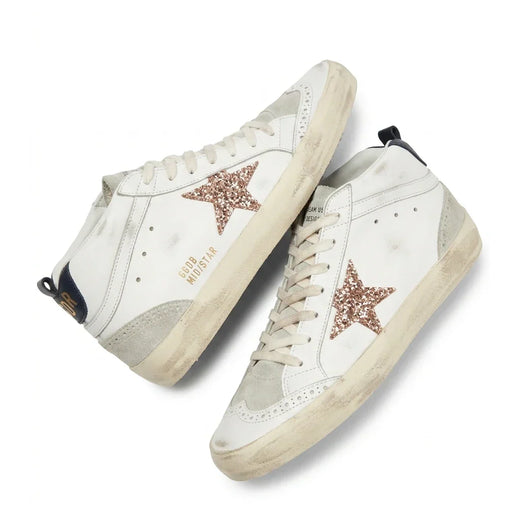
The Ball Star's defining feature is the oversized side star, applied as a separate leather (or suede) piece on each lateral panel. On authentic pairs, the star is both sewn AND glued. The stitching runs around the perimeter of the star at a consistent distance from the edge, with even stitch spacing and thread tension. The leather of the star itself is proper kid leather (or genuine suede on suede variants) with a matte finish, never plastic-feeling PU. The star sits with its top point partially overlapped by the upper panel above it, and the placement is intentionally randomized pair-to-pair. If you compare two authentic Ball Star pairs of the same size and colorway, the star will not sit in pixel-identical position on both.
How Current Fakes Differ
Counterfeit Ball Stars fail on star application in three predictable ways. First, the construction is glued only, with no stitching, or the stitching is decorative and does not pierce the upper. A fingernail under the star edge will lift it on a fake. On authentic pairs it stays anchored. Second, the contrast-leather quality reads as plastic, with a uniform glossy finish where authentic kid leather shows natural grain variation. Third, the placement is locked to a fixed template position, so multiple fake pairs from the same listing show the star in identical position with identical edge gaps. The metallic-red heel tab on classic Ball Star variants is also a tell: authentic metallic finish is a thin painted layer that wears with use, counterfeit metallic is a bright gloss that chips off in single flakes.
Star Application Quick Comparison
| Element | Authentic | Counterfeit |
|---|---|---|
| Construction | Sewn AND glued, stitching pierces upper at consistent distance from edge | Glued only, OR decorative stitching that does not pierce upper |
| Leather quality | Proper kid leather (or genuine suede), matte finish, natural grain variation | Plastic/PU feel, uniform glossy finish, no grain depth |
| Placement randomness | Pair-to-pair variance, no two pairs identical when compared side by side | Locked template position, identical placement across multiple pairs from same listing |
| Star edge stitching | Even stitch spacing, consistent thread tension | Skipped stitches, uneven spacing, thread color slightly off |
| Metallic heel tab (classic variant) | Thin painted layer, wears with use | Bright gloss, chips off in single flakes |
4. How to Evaluate Stitching Density and Tension

- Authentic: seams hold consistent thread density and color-matched waxed thread along every visible seam, with no skipped passes or visible glue residue at the welt.
- Fake: stitching widens the thread spacing along the star perimeter, the thread tone drifts brighter than the matching authentic, and visible adhesive bleeds along the heel-to-midsole transition.
What to Look For
Authentic Ball Star stitching runs at consistent density across every visible seam, with the thread color matched precisely to the leather panel it sits on. The basketball-heritage panel construction means the Ball Star carries more visible seams than the Super Star, particularly along the side panels and around the toe cap. On the inside of the upper, the stitch tension stays even, with no loose threads, no skipped passes, and no doubled-over stitch runs. The thread itself is a tightly twisted nylon or waxed cotton that holds tension under finger pressure rather than slackening.
How Current Fakes Differ
Stitching is the giveaway on otherwise-convincing mid-tier counterfeit Ball Star fakes. The thread color usually runs slightly brighter or yellower than authentic, particularly on white-leather variants where a subtle off-white thread is correct and counterfeit pairs default to pure white. Stitch density varies along the same seam, with the counterfeit needle spacing tightening and loosening as the panel curve changes. Inside the upper, you will commonly see exposed thread tails, glue residue at seam ends, and stitches that pierce the lining inconsistently. The most reliable single tell is to flex the toe box and watch the stitching at the toe cap, authentic stitches hold tension under flex, counterfeit stitches loosen visibly.
Stitching Quick Comparison
| Element | Authentic | Counterfeit |
|---|---|---|
| Stitch density | Consistent along every visible seam | Varies along same seam, tightens and loosens with panel curve |
| Thread color match | Precisely matched to leather panel, subtle off-white on cream variants | Brighter or yellower than authentic, pure white on cream variants |
| Interior finishing | No exposed thread tails, no glue residue at seam ends | Exposed thread tails, glue residue, stitches pierce lining inconsistently |
| Tension under flex | Holds tension when toe box is flexed | Loosens visibly under flex test |
| Thread material | Tightly twisted nylon or waxed cotton, holds tension under finger pressure | Slack thread, often softer cotton-poly, gives under finger pressure |
5. How to Check Glue Lines at the Midsole-to-Upper Joint

- Authentic: joint shows a clean, narrow bond line flush with the welt with no adhesive visible against the white midsole.
- Fake: joint shows a yellowed adhesive bead riding above the welt onto the panel leather, with visible bleed at the heel-to-midsole transition.
Authenticate Your Ball Star
Independent photo authentication by our expert team
What to Look For
Run a fingertip along the line where the rubber midsole meets the leather upper. On an authentic Ball Star, this joint is clean and tight, with no visible glue residue squeezed out from under the upper, no yellowing at the bond line, and no gaps where the upper has separated from the midsole. The bond holds consistently around the entire perimeter of the shoe, including the curved sections at the toe and heel. Italian factory finishing on Golden Goose includes a manual cleanup pass after the upper is bonded to the sole, so any squeeze-out is wiped away before the distressing step is applied.
How Current Fakes Differ
Glue residue is the single fastest tell on mid-tier and lower Ball Star fakes. Counterfeit factories skip the cleanup pass to save labor time, so squeeze-out is visible along the welt as a translucent yellow-brown bead. On some pairs you will see actual gaps where the upper has begun to separate from the sole within months of purchase, because counterfeit adhesive is weaker than the factory original. Yellowing along the bond line also appears within the first year of wear, a sign that the cheaper adhesive is oxidizing. Authentic Golden Goose pairs hold the bond cleanly for years, even with daily wear.
Glue Lines Quick Comparison
| Element | Authentic | Counterfeit |
|---|---|---|
| Joint cleanliness | No visible glue squeeze-out anywhere along the perimeter | Translucent yellow-brown bead visible along the welt |
| Bond consistency | Holds tight around the entire shoe, including toe and heel curves | Gaps where upper has separated from sole, often at toe |
| Adhesive aging | Bond line stays clean for years of wear | Yellowing appears within the first year |
| Cleanup quality | Manual cleanup pass leaves no residue | Skipped cleanup, residue visible at multiple points |
6. How to Read the Sole Pattern

- Authentic: tread carries a dense chevron-herringbone pattern across the full footprint of the black-rubber sole, with the chevrons running tip-down toward the heel at uniform 45-degree angles and a small central logo stamp in the heel zone.
- Fake: outsole widens the chevron line spacing, the chevron angles drift across the sole, the heel logo stamp reads as a flatter rounded impression, and the rubber compound feels foamier under thumb pressure.
What to Look For
Flip the shoe over. The authentic Ball Star outsole shows a dense chevron-herringbone tread pattern with the chevrons running tip-down toward the heel at uniform 45-degree angles, tight line spacing, and a small central logo stamp inside the heel zone. The lines are uniform, the spacing is consistent, and there is no warping or skew along the pattern. The rubber compound feels dense and slightly tacky under thumb pressure, with a total sole thickness of approximately 2.5 cm at the ball of the foot. Around the molded size and serial markings inside the heel area (visible when the insole is lifted), authentic construction shows irregular nail or tack imprints in a loose ring, a real-construction artifact from the factory lasting process.
How Current Fakes Differ
Counterfeit outsoles consistently fail on chevron-herringbone symmetry. The chevron lines skew mid-pattern, the angles drift between 35 and 55 degrees across the sole instead of holding a uniform 45, and spacing tightens or loosens unpredictably particularly around the toe curve where the mold transitions. Rubber compound on fakes feels softer and foamier under thumb pressure, often with visible flash residue from the mold left in the grooves. The central heel logo stamp renders as a flatter, rounder impression where the authentic stamp reads as a crisp raised geometry. Sole thickness varies, with cheaper Ball Star fakes coming in noticeably thinner than the 2.5 cm authentic spec. The nail-mark ring around the heel size markings is either skipped entirely or rendered as a too-uniform circle of identical dots, the irregularity of authentic construction is rarely replicated.
Sole Pattern Quick Comparison
| Element | Authentic | Counterfeit |
|---|---|---|
| Chevron-herringbone angles | Uniform 45 degrees across the sole, tip-down toward the heel | Drift between 35 and 55 degrees, visible skew |
| Chevron line spacing | Tight, consistent across the footprint | Tightens and loosens unpredictably, widens at toe curve |
| Central heel logo stamp | Crisp raised geometry inside the heel zone | Flatter, rounder impression with soft edges |
| Rubber compound | Dense black rubber, slightly tacky under thumb pressure | Softer, foamier, sometimes flash residue from mold in grooves |
| Sole thickness | Approximately 2.5 cm at ball of foot | Often noticeably thinner |
| Heel nail-mark ring | Irregular ring of imprints around size markings, real construction artifact | Skipped, or too-uniform circle of identical dots |
7. How to Read the Hand-Distressing Pattern

- Authentic: distressing shows minimal asymmetric scuff marks on the toe with off-white waxed cotton laces, the leather grain reads with natural depth variation, and Ball Star pairs specifically carry heavier wear on the right shoe than the left.
- Fake: distressing reads as a uniform machine-sprayed haze across both shoes, the laces shift toward a slicker glittery cotton-poly blend, and the scuff geometry mirrors between left and right shoes.
What to Look For
Every authentic Golden Goose pair is hand-distressed in Italy. The dirt streaks, scuff marks, and wax patterns are applied by workers, not machines, so no two pairs are identical, and the left shoe of any given pair does not mirror the right. Look for asymmetric wear at the toe cap, irregular scuff placement along the side panels, and varied intensity of the dirty wash from one zone of the upper to the next. If you are comparing your pair to the Golden Goose product page photo, the distressing should NOT match position-for-position. That mismatch is a feature of the brand, not a defect.
One Ball-Star-specific pattern worth flagging: authentic Ball Star pairs consistently show heavier distressing on the right shoe than the left, a finishing pattern long documented across resale and authentication communities and connected to the brand's skateboarding-inspired design language (skaters typically push off the ground with the right foot). If you are comparing two pairs and the wear pattern is mirror-symmetric left to right, that asymmetry was lost in production, which is a counterfeit signal specific to Ball Star that does not apply to Super Star or Mid Star. The intentional R-heavier distressing is one of the easier model-specific tells once you know to look for it.
How Current Fakes Differ
The hand-distressing variance is the single hardest authentication signal for counterfeit factories to fake, including the top counterfeit grades. Factory-produced fakes use stencils or machine application, so every pair from the same SKU shows identical scuff placement, identical dirt streak patterns, and pixel-perfect mirroring between left and right shoes. The clearest in-store test is to ask a seller for photos of two or three pairs of the same Ball Star colorway and size. If the dirt patterns repeat across pairs, the inventory is factory-distressed, and counterfeit by definition. Even pairs marketed as the highest "top-tier counterfeit" tier cannot defeat this test, because varying the distressing pair-by-pair would require Italian hand-finishing labor that the counterfeit supply chain is not set up to provide.
Distressing Quick Comparison
| Element | Authentic | Counterfeit |
|---|---|---|
| Pair-to-pair variance | No two pairs identical, even within the same SKU and size | Identical scuff placement across multiple pairs from same listing |
| Left-right mirroring | Left and right shoe do NOT mirror, asymmetric application | Pixel-perfect mirroring between left and right shoes |
| Match to product page photo | Should NOT match position-for-position | Often matches the listing photo too closely |
| Distressing intensity | Varied across zones of the upper, irregular by design | Uniform intensity, stencil-applied |
The hand-distressing inversion test is the single highest-value Ball Star authentication tactic for buyers in 2026. Ask any seller for clear photos of two pairs of the same Ball Star colorway and size. Authentic pairs are hand-distressed in Italy, so dirt patterns will visibly differ. Counterfeit factory inventory shows identical distressing across pairs because the process is stencil-applied. This single seller-screening tactic eliminates the entire counterfeit pyramid in one move, including pairs marketed as the top-tier counterfeit grade.
8. How to Check Leather Grain and Suede Quality

- Authentic: leather is full-grain Italian calf with visible natural depth variation, small follicle marks, and a matte hand-feel.
- Fake: upper substitutes a PU or corrected-grain laminate that reads uniformly smooth, the surface lacks follicle marks under macro inspection, and the royal-blue star sits with a glossier patent-look finish that authentic kid leather does not produce.
What to Look For
The Ball Star uses full-grain Italian calfskin on its classic leather variants and proper suede on suede variants. Authentic calfskin shows natural surface variation, with subtle pore distribution, gentle grain pattern, and a slightly stiff feel that softens with wear. When you flex the upper, the leather creases and the creases stay visible, an indicator of real leather memory. Suede variants show a dense, even nap that brushes back to a uniform color when you run a finger across it. The leather around the heel cup feels firm and structured, never floppy.
How Current Fakes Differ
Counterfeit Ball Stars commonly substitute PU (polyurethane) coated leather or split-grain leather for the authentic full-grain calfskin. The give-away is the surface uniformity, fake leather shows no natural pore variation and instead has a printed grain pattern that repeats across the surface. Under flex, PU leather creases and the creases disappear (no leather memory), or the surface cracks visibly under repeated flex. Suede fakes show uneven nap that mats unevenly, or worse, a brushed-effect printed onto a plastic substrate. The heel cup on fakes feels noticeably softer because the leather is thinner.
Leather Grain Quick Comparison
| Element | Authentic | Counterfeit |
|---|---|---|
| Surface variation | Natural pore distribution, subtle grain variance | Printed grain pattern that repeats across the surface |
| Flex behavior (calfskin) | Creases form and stay visible, real leather memory | Creases disappear (PU), or surface cracks under flex |
| Suede nap | Dense, even, brushes back to uniform color | Uneven nap, mats unevenly, or printed onto plastic substrate |
| Heel cup structure | Firm, structured, holds shape | Soft, floppy, thinner leather |
9. How to Read the Tongue Label and Heel Tag

- Authentic: label reads GGDB in compact capitals above MADE IN ITALY and SIZE___, all in deep matte black ink on a clean white woven backing bound by a royal-blue heel tape.
- Fake: label preserves the same line order, but the SIZE underscore reads as a faded short rule, and the heel-tape blue runs duller and less saturated.
Your Items, Verified
Cross-checked by two experts, 99.3% accuracy rate
What to Look For
The Ball Star carries two important branded labels, the tongue label and the heel tag. The tongue label is woven (not printed) with the GGDB or Golden Goose wordmark, sizing in EU/US/UK format, and "Made in Italy". Stitching around the tongue label is precise, with no fraying or loose threads. The heel tag is the more diagnostic of the two. Look for "GOLDEN GOOSE" or "GGDB" embossed into the leather or printed cleanly on the tab. the single most cited authentication tell on the heel tag is the G-O ligature in the word "GOOSE". On authentic pairs, the G and the first O are connected as a single ligature, with no visible gap between them. Every letter in the heel text is uppercase, never lowercase. Stroke weight is uniform across the whole word, and the emboss depth is even.
How Current Fakes Differ
Counterfeit heel tags fail on the GOOSE ligature with remarkable consistency, even at the top-tier counterfeit grade. Fake tooling renders G and O as two separate letters with a clear gap between them. Stroke weights vary letter-to-letter, with the N in particular often noticeably thinner or thicker than the surrounding letters. Emboss depth fluctuates across the word because fake molds wear unevenly. On the tongue label, counterfeit fakes commonly use a printed (not woven) label, with sizing format that uses non-standard abbreviations and "Made in Italy" rendered in a generic serif instead of the brand's proprietary typeface. Any tongue label or heel tag claiming "Made in China", "Made in Korea", or "Made in Vietnam" is a definitive fake indicator, Golden Goose produces only in Italy.
Tongue Label and Heel Tag Quick Comparison
| Element | Authentic | Counterfeit |
|---|---|---|
| Tongue label construction | Woven, not printed | Printed label, sometimes glued not stitched |
| Heel tag GOOSE ligature | G and O connected as single ligature, no gap | G and O as separate letters with visible gap |
| Heel text case | All uppercase, every letter | Sometimes mixed case, or letters of mismatched height |
| Stroke weight | Uniform across the whole word | Varies letter-to-letter, N often thinner or thicker |
| Emboss depth | Even, consistent pressure across all letters | Fluctuates, fake molds wear unevenly |
| Country of manufacture | "Made in Italy" only | Any non-Italy stamp is a definitive fake indicator |
The heel tag GOOSE ligature is the single most cited typography tell among authentication labs and experienced collectors. On authentic Ball Star heel tags, the G and the first O of GOOSE physically touch as a single ligature. Counterfeit tooling almost universally renders them as separated letters with a visible gap.
Method: Read The Box And Tongue Code (GMF, GWF, GJF)
One overlooked authentication step on the Golden Goose Ball Star is reading the 22-character item code printed on the box label and on the tongue label inside the shoe. The same string appears on the box, on the tongue, and in the URL of the matching product page on goldengoose.com. Mismatch between box and tongue is one of the highest-value tells you can run without sending anything to a lab.
Flip the box and find the white sticker. You are looking for a 22-character string with two dots in it, formatted like GMF00117.F003771.10283. The first three letters are the category, GMF for men, GWF for women, GJF for kids, GYF for in-between sizing on certain Junior runs. The next five digits are the model family. Super-Star is 00101, Ball Star is 00117, Hi Star is 00118 or 00119, Mid Star is 00122. The F-block in the middle is the colorway recipe, and the final five digits are the finish index that also matches the EAN barcode on the box. The same code has to appear on the tongue label inside the shoe.
| Block | What it means | Example (Ball Star) |
|---|---|---|
| Prefix (3 letters) | Category: GMF men, GWF women, GJF kids, GYF in-between | GMF |
| Model code (5 digits) | Model family. Ball Star is 00117. | 00117 |
| F-block (F + 6 digits) | Colorway recipe. Changes across colorways of the same model. | F003771 |
| Finish index (5 digits) | Internal finish index, also encoded on the EAN box sticker. | 10283 |
| Box vs tongue match | Same string must appear on box, tongue, and goldengoose.com URL. | Cross-check required |
Five malformed-code red flags worth knowing
- Wrong prefix for the gender (GWF code on a men's pair, or GMF on a women's pair). Factories regularly mismatch box and tongue across counterfeit runs.
- Wrong character count. Any block shorter or longer than the canonical 3-5-7-5 distribution. Real codes are always 22 characters including the two dots.
- Missing dot separators. Some fakes print the code as one continuous string.
- GJF (junior) prefix on an adult-size pair, or any prefix that does not align with the size printed on the same label.
- Box code that does not appear when you paste the F-block into Google. Newer-season pairs should surface a matching goldengoose.com product page. Archived pairs will not, so this is necessary-but-not-sufficient.
The honest verification path
Worth correcting a common piece of misinformation. There is no public goldengoose.com/verify portal. The URL returns HTTP 410 Gone, the brand customer-care and FAQ pages do not mention it, and the claim only appears on AI-generated content farms. Anyone telling you to "look up your code on the official verify page" is repeating bad information that has been laundered across multiple third-party blogs.
The realistic free check is to photograph the box label, paste the F-block from your box into Google with quotes around it, like "F003771.10283", and confirm the matching product page on goldengoose.com shows the colorway you actually received. Then compare that same code character-for-character against the tongue label inside the shoe. If both checks pass, the code is consistent with a real Ball Star run. If the box code does not match the tongue, or if the colorway on the goldengoose.com page does not match what you have in hand, treat the pair as suspect and run the rest of the checkpoints in this guide before paying.
For a confident verdict on a $400 or more pair where the code looks right but you still want a professional read, request a LegitGrails authentication report and we will cross-reference the printed code against the visual checkpoints that counterfeit factories cannot copy at scale.
Method: The Price Floor Check
Price is the fastest pre-purchase filter on Golden Goose Ball Star. Counterfeit inventory consistently sits below the authentic secondary-market floor, and a sub-floor listing is the single most reliable indicator that something is off before you even look at the photos.
Authentic Ball Star retails at $595 to $1,330 USD on goldengoose.com US in 2026, with classic leather variants typically $595 to $695 and embellished or limited variants reaching the top of the range. Pre-owned authentic pairs sell for $300 to $450 on Vestiaire Collective, StockX, and reputable consignment platforms. Listings below $300 should trigger immediate authentication verification, that is the counterfeit pricing floor below which legitimate inventory does not exist on the secondary market.
Use the price floor as a gate, not as a final verdict. Authentic pairs at or below the floor exist on rare occasions through outlet liquidation or genuine private resale, but the asymmetry runs heavily toward counterfeit at those prices. If the listing meets the floor, run the ten checkpoints above. If the listing is below the floor, treat as suspect and require multiple authenticator-grade photos before paying.
10. How to Authenticate the Dust Bag and Authenticity Card

- Authentic: bag prints "® FOR DREAM USE ONLY / NOT DESIGNED FOR / OTHER ACTIVITIES" in deep matte black centred on a heavyweight cream cotton weave, with "GOLDEN GOOSE PROPERTY / est. 2000" centred underneath at smaller scale and a small clearly drawn registered trademark above the top line.
- Fake: bag preserves the three primary lines of text but the cotton weave runs thinner and shinier, the line spacing widens, the GOLDEN GOOSE PROPERTY footer prints fainter, and the registered trademark circle reads as a thicker, lower-contrast outline.
What to Look For
The Ball Star ships with a cotton dust bag printed with the GGDB or Golden Goose wordmark in dark ink, and a small authenticity card with a foil-stamped logo. Two often-overlooked tells. First, the foil logo on the authenticity card is rose-gold, a warm pink-gold tone. It is never pure yellow-gold. Second, the GGDB letters on the dust bag have sharp edge tension with high contrast against the cotton, and the tag paper itself has a matte front and rough back. The laces also carry a small branded aglet (the plastic or metal tip) on each lace end, with controlled stretch and a slightly waxy feel.
How Current Fakes Differ
Dust bag and card counterfeits show three predictable failures. The authenticity card foil reads as pure yellow-gold, brighter and visibly "cheaper" under daylight than the authentic rose-gold. The dust bag GGDB letters have fuzzy edges with lower contrast against a thinner cotton weave, and both sides of the tag paper feel the same (no front-back texture differentiation). The lace aglets are commonly skipped entirely, with fakes using plain plastic tips or no tip at all. Lace fabric on fakes is softer and slipperier, a cotton-poly blend instead of authentic waxed cotton. One important caveat: a correct dust bag and card alone do NOT confirm authenticity. Packaging is the easiest component to counterfeit and the easiest to swap, so weigh it last in your overall assessment.
Dust Bag and Card Quick Comparison
| Element | Authentic | Counterfeit |
|---|---|---|
| Authenticity card foil | Rose-gold, warm pink-gold tone | Pure yellow-gold, brighter and cheaper-looking |
| Dust bag print | Sharp edge tension, high contrast against dense cotton | Fuzzy edges, lower contrast, thinner cotton weave |
| Tag paper texture | Matte front, rough back, clear differentiation | Both sides feel identical, no front-back differentiation |
| Lace aglets | Small branded aglet on each lace tip | Plain plastic tips or no tip at all |
| Lace fabric | Waxed cotton, controlled stretch, slightly waxy feel | Cotton-poly blend, softer, slipperier |
Looking to Purchase a Ball Star?
The Golden Goose Ball Star is the highest-volume search target in the Star family, with around 4,400 monthly searches on Google for the model name alone in 2026. That popularity also makes it the most-targeted Ball Star variant for scam outlets and counterfeit-mixed inventory. Current retail pricing sits at $495 to $695 USD for the classic leather variants, with suede and glitter variants reaching $750. Secondary-market authentic floors run $300 to $450 on Vestiaire Collective, StockX, and reputable consignment platforms.
Before you complete a Ball Star purchase, particularly from a discount listing below $300, see our where to buy authentic Golden Goose guide. It names the verified retailers across the United States, Europe, and Asia, the specific scam domains currently operating under names like "goldengoose-outlet.com" and "goldengoosesale.com", and the platform-specific red flags on Pinduoduo, Xianyu, and WeChat resellers.
For buyers in Greater China, the only fully verified Golden Goose retail surface as of 2026 is the brand's official channel network: Tmall flagship + WeChat flagship + JD flagship + Douyin flagship + Xiaohongshu flagship + designated Greater China boutiques. Anything outside this set requires independent authentication. See our vetted retailers list for the full international breakdown.
What Are the Red Flags of a Fake Golden Goose Ball Star?
Definitive Fake Indicators
- "Made in China", "Made in Korea", or "Made in Vietnam" stamp on tongue label or box (Golden Goose produces only in Italy)
- Insole perforations do not spell GG (left) and DB (right), or right-foot label is opaque white
- Star application is glued only with no stitching, or stitching is decorative and does not pierce the upper
- Box silver foil does NOT lift under fingernail pressure (authentic foil is deliberately fragile)
- Heel tag GOOSE shows G and O as separated letters with a visible gap
- Two pairs of the same Ball Star size and colorway from the same seller show identical distressing patterns
Highly Suspicious Indicators
- Listing price significantly below $300 USD (authentic resale floor)
- Seller uses counterfeit-tier vocabulary in description (any of "factory-overrun", "tail-order", "original-order", "1:1", "1:1 replica", "top version", or "top-grade")
- Authenticity card foil is bright yellow-gold instead of warm rose-gold
- Sole wave pattern shows skew or warping along the tread lines
- Lace aglets are plain plastic tips or skipped entirely
- Stitch density varies along the same seam, particularly inside the upper
- Yupoo gallery link, WeChat micro-merchant reseller, or Pinduoduo listing below $275
According to U.S. Customs and Border Protection seizure data, Italian-made luxury footwear remains a recurring counterfeit category at U.S. ports of entry. If you have spotted any of the indicators above on a Ball Star you are considering, verify your Ball Star with our authenticators before completing the purchase.
Check Your Pair Now
Trusted by over 100K users worldwide
Why Today's Ball Star Fakes Are Harder to Spot
I will be honest with you. Spotting a fake Golden Goose Ball Star in 2026 is harder than it was five years ago. The pairs we are seeing in 2025 and 2026 would have fooled me at that point, these are not the obvious knockoffs you used to spot from across a room. The overseas counterfeit supply chain has matured into a tier-graded production network with multiple sub-variant labels layered on as counterfeit-market marketing tags (including a Dongguan-origin tier marketed as a high-end variant), and the pairs marketed as the top-tier counterfeit grade in particular have closed most of the obvious visual gaps. Across thousands of Golden Goose submissions to our lab between 2022 and 2025, the share of Ball Star pairs that pass an "across the room" test but fail authentication has roughly tripled. Worth noting, these tier names are counterfeit-market marketing language, not evidence of any genuine link to the Italian factory supply chain. The International Trademark Association tracks how such counterfeit-market vocabulary has industrialized over the past decade, with tier-graded production networks now standard across most luxury footwear categories. The good news for buyers, the diagnostic stack the brand built in (the oversized side star sewn-AND-glued construction, the GG and DB insole perforations resolving as readable letters, the heel-tag GO ligature, and the right-shoe-heavier hand-distressing asymmetry) has stayed stable across every generation of counterfeit improvement, so a five-minute check still rules out the bulk of fakes in circulation.
As of 2026, counterfeit Ball Star production has fixed most of the obvious problems. Leather quality on pairs marketed as "top-tier counterfeit" reads as proper calfskin under casual inspection. Stitch density runs within 90% of authentic spec. Heel tag emboss depth has improved generation over generation. Hardware finish has shifted from obvious zinc to a yellow-brass alloy that holds plating tone for the first year of wear.
Where Superfakes Still Fall Apart
Three structural failures still catch the top-tier Ball Star fakes in our lab, even in 2026. First, the hand-distressing variance, factory production cannot economically vary the dirt pattern pair-by-pair, so multi-pair photos from the same seller expose stencil distressing immediately. Second, the GG/DB insole perforation with the transparent right-foot label, the substrate for the transparent label is rarely sourced correctly even on pairs marketed as "top-tier counterfeit". Third, the star application sewn-AND-glued construction, the factory shortcut is glued-only with decorative top stitching, and a fingernail under the star edge will still lift it on fakes that pass everything else.
How Ball Star Fakes Have Evolved Since 2020
The progression has been instructive to watch from the authentication side. The 2020 generation of Ball Star fakes used PU instead of calfskin and was obvious on touch alone. By 2022, the counterfeit "mid-tier counterfeit" tier had switched to genuine leather and improved the box label print, but the heel tag GOOSE ligature still failed consistently. By 2024, the producers marketing "top-tier counterfeit" had closed the heel tag gap and improved the sole rubber compound to within touch-test range of authentic. The 2026 generation has added partially-correct GG/DB insole perforation patterns, though the transparent-label substrate failure persists. Where this leaves us: the diagnostic stack has shifted away from single-tell verification toward cross-referencing multiple subtle signals across the entire shoe, exactly the kind of pattern-recognition work our lab does on every submission.
What About the NFC Tag?
Golden Goose first introduced NFC authentication in November 2019 with the limited-edition Yeah sneaker, a 300-pair run priced at €410 sold exclusively through the brand online store, then expanded to wider colorways in physical stores from December that year (per NFC World, 15 November 2019, citing WWD). That pilot is the historical anchor for everything that followed across the Ball Star catalog. Recent Golden Goose production has started embedding NFC tags into select pairs, scannable through the official Golden Goose app. Two things worth knowing for Ball Star specifically. First, not every Ball Star ships with NFC, particularly older production runs and certain colorway runs, so the absence of a working NFC scan does not by itself indicate counterfeit. Second, counterfeit factories have begun cloning NFC chips and tying them to spoofed app responses, so a positive scan is supporting evidence, not a complete authentication. I treat NFC the same way I treat the box label or the dust bag: useful when it is present and correct, not decisive on its own. The diagnostic stack still comes back to the visual checkpoints in this guide, particularly the GG/DB insole perforation, the heel tag GOOSE ligature, the hand-distressing variance, and the right-shoe asymmetric wear specific to Ball Star.
Can You Authenticate Golden Goose Ball Star Yourself?
Here is the honest answer, this guide will help you spot obvious fakes, the kind sold openly on Pinduoduo, Yupoo, WeChat micro-merchant channels, and discount websites under $300. For the category that costs you $400 or more on resale, even with this guide in hand, an untrained eye misses details a trained one catches. That is the gap professional authentication closes. Golden Goose has good superfakes circulating in 2026, comparable in difficulty to spotting a fake Super Star and slightly easier than authenticating the platform-sole Hi Star high-top variant. Ball Star sits in the middle of the difficulty band for self-authentication, the oversized side star is more buyer-actionable than the Hi Star platform geometry but less self-evident than the perforated brogue toe of the Mid Star perforated leather upper.
LegitGrails is a photo-based authentication service. We work from high-resolution submission photos rather than handling shoes in person. That means there are some buyer-actionable physical tests we cannot perform for you, but we can teach you to perform them yourself: the fingernail test on the box silver foil, the multi-pair distressing comparison via seller-supplied photos, the fingernail lift test on the star edge, and the flex-and-watch test on the toe-box stitching. None of those require our lab. What our lab adds is the trained-eye pattern recognition across the GG/DB insole perforation cleanness, the heel tag GOOSE ligature precision, the sole wave-pattern symmetry, the stitching tension consistency, and the leather grain authenticity, signals that take years of side-by-side reference work to read fluently from a photo.
A note on Reddit and PurseForum community checks. The r/GoldenGoose subreddit, r/SneakerLegitCheck, r/LegitGrailsHub, and the PurseForum Golden Goose mega-thread all run informal legit-check posts where collectors and longtime owners weigh in for free. They are useful for screening obvious red flags. The limit is that community expertise varies widely and a confident-sounding wrong answer can cost you the price of the shoe. For pairs at the $400 or more end of the resale range, the marginal cost of a paid authentication review ($15 to $35) is small compared to the downside of accepting a counterfeit on community consensus.
Start with the top four checkpoints in the summary table: oversized star application, GG/DB insole perforation, heel tag GOOSE ligature, and hand-distressing pattern. These four checks rule out the obvious copies. For a confident buy or sell decision on a $400 or more pair, request a LegitGrails authentication report that cross-references 10 to 12 details against thousands of reference pairs.
Professional authentication of a Golden Goose Ball Star costs $15 to $35 and is worth it for any pair priced above $300 on the secondary market. Roughly one in three Golden Goose pairs submitted to our lab close as counterfeit. Counterfeit signals on pairs marketed as the top-tier counterfeit grade are visible only across multiple cross-referenced details, which is exactly the workflow professional authentication delivers.
Other Golden Goose Models
Looking to authenticate a different Golden Goose model? See our model-specific guides:
- the iconic Super Star authentication guide, the classic low-top that started the Star family
- Hi Star authentication guide, the high-top variant with leather collar and platform sole
- Mid Star authentication guide, the mid-cut sibling with perforated leather
- where to buy authentic Golden Goose, vetted retailers across the United States, Europe, and Asia, plus named scam outlet domains to avoid
Get 20% Off Your First Authentication
Free authentication guides and expert tips
No spam. Unsubscribe anytime. Privacy Policy
Thanks! Check your email, we just sent your welcome discount code.
Which Ball Star Checks Are Most Reliable
Not every checkpoint in this guide carries equal weight. Four read as standalone authenticity signals where a single failure means the pair is counterfeit, the heel tab G-O ligature with connected letters, the GG and DB perforations on the underside of the insole, the oversized side-star application sewn through the upper with stitch perforations piercing the leather, and the right-shoe-heavier hand-distressing asymmetry unique to the Ball Star. Three read as combined signals that confirm a top-tier counterfeit when paired with the high-weight signals, the box label article-string format and Made in IT origin, the chevron-herringbone outsole angle uniformity, and the seam stitching density across the toe cap and side panel. The remaining three (midsole glue line cleanliness, leather grain depth, dust bag weave density) are supporting signals that catch lower-tier fakes but are also the easiest for counterfeit production to reverse-engineer once the leading signals are clean. If you can only run three checks on a Ball Star pair you are considering buying, run the heel tab G-O ligature, the insole GG and DB perforations, and the right-shoe distressing in that order.
Frequently Asked Questions
How do you tell real Golden Goose Ball Star from fake?
Start with the oversized side star application, which should be both sewn AND glued, with stitching that pierces the upper and edge placement that varies pair-to-pair. Then check the insole perforation pattern, the left insole holes should spell "GG" and the right should spell "DB", paired with a transparent right-foot label. Finally, examine the heel tag for the GOOSE ligature, where authentic pairs show G and O connected as a single letter. These three checks rule out the obvious copies. For a confident decision on a $400 or more pair, request a LegitGrails authentication report.
How is Ball Star different from Super Star?
The Ball Star is a low-top sneaker with basketball heritage from 1980s American college courts, distinguished by an oversized side star application that runs larger than the Super Star's star and extends from the midsole well up onto the upper panel. The Ball Star also has a flatter toe profile, a slightly lower-cut collar, and a vintage college-court reference in the panel construction. The Super Star uses a smaller, proportionally placed star in a more classic low-top silhouette. Both are heavily counterfeited, but the star size and proportion are the immediate visual differentiator.
Can a fake Golden Goose Ball Star have a real box?
Yes, box-swap fraud is a known tactic in Ball Star resale. Counterfeit shoes are sometimes shipped with authentic boxes recovered from outlet returns or secondary-market purchases. The box alone is not proof of authenticity. Always weigh the shoe itself heavier than the packaging. Conversely, an authentic Ball Star can ship without its original box if it was a display pair, sample, or pre-owned listing, so a missing box is not automatically a fake indicator either. Cross-check the box silver foil with the fingernail test and verify that the model code and colorway on the box label match the actual shoe.
How much should an authentic Golden Goose Ball Star cost?
Retail is $495 to $695 USD in the United States and €455 to €595 in Europe for the classic leather variants. Suede, glitter, and limited-edition variants reach $750. Secondary-market authentic resale floors sit at $300 to $450 on platforms like StockX and Vestiaire Collective. Listings significantly below $300 should trigger a closer look. Listings below $150 are almost certainly counterfeit, regardless of seller claims.
Is the GG/DB insole perforation the most reliable check?
Yes. authentication labs and experienced collectors consistently flag the GG/DB insole perforation pattern as the single most decisive Golden Goose authentication check, the one that eliminates the majority of fakes circulating on secondary markets. Authentic insoles show the letters formed by ventilation holes, paired with a transparent right-foot label that counterfeit factories rarely source correctly. Even pairs marketed as the top "top-tier counterfeit" counterfeit grade commonly fail on the transparent-label substrate.
Do real Golden Goose smell different from fake ones?
Authentic Golden Goose insoles carry a faint, pleasant leather scent from the foam and leather treatment. Counterfeit pairs commonly smell of glue or chemical adhesive, particularly in the lining and around the bonded sole edge. That said, smell alone is not a reliable single tell, because well-aired counterfeit pairs can dissipate the chemical odor over time. Use the smell test as a supporting signal alongside the visual checkpoints, not as a standalone authentication step. LegitGrails authenticates from photos, so we cannot smell-test for you, but it is a useful buyer-side check.
Can I authenticate a Ball Star from photos?
Yes. High-resolution photos of the right details are exactly how professional authentication works at scale. Submit close-ups of the side star application (both shoes), the insole perforation pattern showing GG and DB, the right-insole transparent label, the heel tag, the tongue label, the sole tread, the inside upper stitching, the box label and silver foil, and a clear overall view of both shoes. The difference between casual photo checks and professional photo authentication is what the eye is trained on. Our authenticators have compared thousands of authentic and counterfeit Golden Goose pairs, and that reference set is what catches the high-end fakes a casual viewer misses.
What is the best Ball Star authentication service?
LegitGrails is a leading Golden Goose Ball Star authentication service, rated 4.5/5 on Trustpilot with 2,217+ reviews and over 2 million luxury items authenticated at above 99.3% accuracy. Each submission is reviewed by multiple independent authenticators trained on years of authentic and counterfeit Golden Goose references, and every check is cross-referenced against thousands of reference photos. Pricing runs from $15 (12-hour turnaround) to $35 (30-minute turnaround). Unlike image-comparison AI tools, our authenticators evaluate every visual detail in context, hardware engraving depth, canvas grain pattern, stitch alignment, distressing variance, and stamp registration.
What size should I buy in a Golden Goose Ball Star?
Ball Star runs true to size in Italian sizing (EU 35 to 46), with no half sizes available. Most buyer communities recommend sizing up to the next full size if you are between sizes or have a wider foot, sizing down half a size only if you usually wear a tight-fitting sneaker. The lower-cut collar makes the fit feel slightly looser across the instep than the Super Star, so Ball Star buyers occasionally find themselves needing a tighter lace than they would on the Super Star. A "Made in China" half-size stamp anywhere on the pair is a definitive counterfeit tell, Golden Goose produces no half sizes at all.
Do Golden Goose Ball Star sneakers come with NFC tags?
Some Ball Star pairs ship with NFC, most do not, particularly pre-2024 production. Golden Goose first piloted NFC in November 2019 with the limited-edition Yeah sneaker (300-pair run at €410, per NFC World), then expanded Golden Passport tags into selected newer production runs. To scan, open your phone camera and hold it about 3 cm from the front of the right shoe, the Golden Passport app opens the registered product page. A missing NFC tag is not a fake indicator on its own, and a positive scan is not a substitute for the heel-tag GO ligature and the GG and DB insole perforation checks.
Why is the right shoe of an authentic Ball Star more distressed than the left?
Authentic Ball Star pairs consistently show heavier hand-distressing on the right shoe than the left, a finishing pattern that traces back to the brand's skateboarding-inspired design language because skaters typically push off the ground with the right foot. The asymmetry is applied by hand at the Italian factory and varies between pairs. Mirror-symmetric distressing across both shoes of a Ball Star is a counterfeit signal specific to this model that does not apply to the Super Star or Mid Star, where left-right variance is present but not directional.
Are Golden Goose Ball Stars supposed to look scuffed?
Yes. The scuffed, distressed finish is a deliberate design choice, not a defect. Every authentic Ball Star is hand-distressed in Italy with dirt streaks, scuff marks, and a wax finish applied by workers, not machines. On Ball Star specifically, the right shoe is intentionally distressed slightly more than the left, referencing the basketball and skateboarding heritage the model draws from. If the scuffing on your pair looks too symmetric, too uniform, or pixel-identical to the listing photo, that is actually a counterfeit signal. Authentic distressing should look hand-applied and asymmetric.
Are Golden Goose Ball Stars still in style in 2026?
Yes. Golden Goose Ball Star remains a top-volume model in 2026, with around 4,400 monthly Google searches for the model name in the United States alone. The brand continues releasing new Ball Star colorways quarterly, and the model holds resale floors of $300 to $450 on Vestiaire Collective and StockX, which is a strong secondary-market signal. The basketball-heritage silhouette has crossover appeal between streetwear and luxury that has kept it relevant across multiple style cycles. If you are buying authentic, the style cycle is not the risk factor. The risk factor is counterfeit inventory at every price tier, which is exactly what the ten checkpoints in this guide cover.
What is the difference between Golden Goose Ball Star and Converse All Star?
They are different brands and different shoes. Golden Goose Ball Star is an Italian-made luxury sneaker (retail $495 to $695) with a hand-distressed finish, an oversized side star application, and a basketball-heritage low-top silhouette. Converse All Star (or Chuck Taylor All Star) is an American mass-market sneaker (retail $55 to $90) with a canvas upper, a vulcanized rubber sole, and a star inside a circle patch on the ankle. They are sometimes confused in search results because both reference basketball heritage and both use a star logo. If you are trying to authenticate a Converse All Star, see the Converse authentication checks specific to that brand. The ten checkpoints in this guide cover only Golden Goose Ball Star.
Where do I find the Golden Goose Ball Star serial number?
Golden Goose does not use a public-facing serial number lookup system the way some sneaker brands do. The closest equivalent is the internal model code printed on the box label (format GMF00117.F-block.finish, like GMF00117.F003771.10283, 19 characters in three dot-separated blocks) and on the tongue label inside the shoe. To inspect the model code, lift the insole and look at the inside-heel area where Italian factory markings are visible, then cross-reference against the model code on the box label and the tongue label. All three should match. The box label model code on its own does not prove authenticity, because boxes can be swapped from authentic pairs to counterfeit shoes. Treat the model code as one data point among the ten checkpoints in this guide, not as a standalone verification step.
Do Golden Goose Ball Stars have a hidden wedge or lifted insole?
Not in the sense of a concealed platform. The Ball Star has a flat low-top silhouette, with a standard insole height that sits comfortably without giving extra elevation. What buyers sometimes notice as a 'wedge' is the slight insole lift inside the heel area, which is a normal cushioning feature, not a hidden platform. If you are looking for the Golden Goose model with a true platform sole, that is the Hi Star (high-top with thick platform), not the Ball Star. Some counterfeit Ball Star pairs come in with a noticeably thinner insole than authentic, so insole height can actually work as a counterfeit signal. The authentic Ball Star insole has firm foam with a slight lift in the heel that retains shape when pressed, counterfeit insoles compress flat and lose loft after a few wears.
Can I get a Golden Goose Ball Star legit check on Reddit?
Community legit-check threads exist on r/GoldenGoose, r/LegitGrailsHub, r/SneakerLegitCheck, and PurseForum's Golden Goose mega-thread. They are useful for a sanity check on obvious red flags, free, and often answered within a day. The honest limit is that community votes vary in expertise, some commenters are experienced collectors and some are guessing from a single phone photo, so a confident community verdict on a $400 or more pair carries real risk. For pairs you actually plan to buy or sell, a paid authentication review by a service that compares your photos against thousands of authentic and counterfeit reference pairs is the higher-confidence route. LegitGrails turnaround runs from $15 (12-hour) to $35 (30-minute) and every submission is reviewed by multiple independent authenticators.
Is Golden Goose one of the most-faked sneakers?
Golden Goose is consistently among the top-counterfeited Italian-made luxury footwear brands, alongside Gucci, Balenciaga, Common Projects, and Maison Margiela. The U.S. Customs and Border Protection regularly names Golden Goose in seizure reports, and the OECD's global counterfeit-trade research lists footwear among the most-seized categories at international borders. Across thousands of Golden Goose submissions to our lab between 2022 and 2025, roughly 30% turn out to be counterfeit, which is in line with the brand-wide rate for the entire Star family including Ball Star. The Ball Star sits in the most-counterfeited band specifically because its $495 to $695 retail and $300 to $450 resale floor are attractive to counterfeiters and to aspirational buyers shopping secondary markets.
What does PVT LTD on my Golden Goose Ball Star label mean?
Treat PVT LTD on a Golden Goose Ball Star interior label as a red flag, not a benign stamp. Authentic Italian-made Golden Goose does not carry a PVT LTD corporate marker anywhere on the shoe. Where the marking shows up, it usually traces to either distributor-side paperwork that was never meant to reach the consumer, or to counterfeit production that has stamped a fictional subsidiary on the inside label. The authentic Made in Italy mark sits on the outsole and on the tongue label printed line, never on a freestanding PVT LTD stamp. If your Ball Star carries a PVT LTD label and you are unsure of the purchase channel, run the GG/DB insole perforation check, the heel-tag GOOSE ligature check, and the box-vs-tongue code cross-check from this guide before assuming the pair is authentic.
Are Golden Goose Ball Stars worth the $500-plus price tag?
Per r/GoldenGoose community threads, the Ball Star is consistently ranked as the most comfortable model in the Golden Goose lineup, with the most generous toe box and the most streetwear-leaning silhouette of the Star family. Whether the $495 to $695 retail is worth it for you comes down to cost-per-wear math. If you will wear the pair 100 or more times, the Ball Star tends to land well on that metric per long-term wearers. If the purchase is aspirational and the shoe will sit in the closet, the Super Star is the safer entry at a similar price point because it carries the classic Golden Goose silhouette with broader resale demand. This is a value question, not an authentication question, but it is the one buyers ask most often before committing to the spend.
Do Golden Goose Ball Stars wear out faster than other Golden Goose models?
Yes, per r/GoldenGoose long-term wearers. The Ball Star outsole wears faster than the Mid Star or Hi Star, with the heel and the ball of the foot showing the first signs of abrasion. Community-recommended fix: a cobbler-applied rubber half-sole extends life significantly without changing the silhouette. Important authentication callout, this is a WEAR pattern, not an authenticity tell. Authentic Ball Star outsoles wear evenly across the contact zones. Counterfeit pairs typically show a different failure mode entirely, the sole compound chunks unevenly in blocky pieces rather than abrading smoothly. If your pair is wearing fast but the abrasion looks even and continuous, that is the expected Ball Star wear curve, not a counterfeit signal.
What do the letters GMF or GWF mean on my Golden Goose Ball Star box?
GMF is men's footwear, GWF is women's footwear, GJF is kids. The three letters are followed by a five-digit model code (Super-Star is 00101, Ball Star is 00117, Mid Star is 00122, Hi Star is 00118 or 00119), then a dot, then an F-code that defines the colorway, then a dot, then a five-digit finish index. The full string is 19 characters and should be identical on the box sticker, the tongue label inside the shoe, and the product page URL on goldengoose.com. The Ball Star adult runs specifically carry the model code 00117.
Can I verify my Golden Goose Ball Star code on the brand's website?
No. There is no public goldengoose.com/verify portal, even though several authentication blogs claim there is. The URL returns an HTTP 410 Gone error and the brand customer-care and FAQ pages do not mention any code-lookup tool. Newer pairs (roughly 2023 forward) ship with an NFC chip in the right shoe that registers with the Golden Passport app, but coverage is not universal and older pairs have no chip. The realistic free check is to search the F-code block from your box on Google, confirm the matching product page on goldengoose.com shows the same colorway you received, and verify the box code matches the tongue label exactly.
Is there a Golden Goose authentication service?
Yes, LegitGrails offers a photo-based Golden Goose authentication service covering the full Golden Goose catalog including Ball Star, Super Star, Hi Star, Mid Star, Stardan, Dad-Star, and limited drops. Upload clear photos of the heel tab, insole, dust bag, and box label, and our team cross-references the heel tab G-O ligature, GG and DB perforation alignment, hand-distressing variance, Italian production stamp, and Golden Passport NFC where applicable against thousands of authentic and counterfeit reference pairs. The brand also runs internal authentication via the Golden Passport app for tagged pairs, but app coverage is partial and counterfeit tag URLs have been documented, so the structural checks remain primary. The full brand-level checklist sits in our Golden Goose buyer's guide.