How to Tell If Jordan 11s Are Fake: Real vs Fake Guide

Last Updated on:
Updated November 2026
30-second checklist for a Jordan 11
- Read the style code inside the tongue: 378037 for men's retros up to the 2019 Bred, CT8012 from the 2020 Jubilee on.
- Look at the heel from behind: a bulky, wide U-shape is a common fake trait.
- Check the Jumpman on the heel and the 23 (45 on the 2018 Concord).
- Check where the patent leather is cut against a genuine pair of the same release.
- Look at the carbon fiber plate through the sole for a real woven pattern with depth.
- Match the barcode on the tag with the box label, and check the code beside the QR.
- If one check fails or you are unsure, get the pair authenticated.
To tell if Jordan 11s are fake, first find out which release you have from the style code on the size tag, then compare the Jumpman and the number on the heel, the patent leather cut, the carbon fiber plate under the sole, the icy outsole, the toe box and shape, and finally the size tag and box label with a genuine pair of the same release. A good fake passes most checks and fails one or two, so check them all.
This guide covers the checks that apply to every Air Jordan 11 retro, with links to our colorway guides for the details of each pair. For checks that apply to every Jordan model, see how to tell if Jordans are fake.
Table of Contents
[ open ]Which Jordan 11 Do You Have?
Jordan has re-released the 11 many times, and each retro has its own style code, patent height, heel details and box. A genuine pair from one year can look wrong next to photos of another, so read the style code on the size tag first and compare only with the same release. Men's retros up to the 2019 Bred use codes starting 378037, and those from the 2020 Jubilee on use CT8012.
- Bred, 2019: 378037-061. See our Jordan 11 Bred guide.
- Concord, 2018: 378037-100, with 45 on the heel. See our Jordan 11 Concord guide.
- Cool Grey, 2010: 378037-001. The 2021 Cool Grey retro is CT8012-005. See our Jordan 11 Cool Grey 2010 guide.
- Jubilee, 2020: CT8012-011, black patent with silver details for the model's 25th anniversary. See our Jordan 11 Jubilee guide.
- Gratitude, December 2023: CT8012-170, white leather with black patent. See our Jordan 11 Gratitude guide.
- Legend Blue, 14 December 2024: CT8012-104, $230 at release.
- Rare Air, November 2025, and Gamma Blue, 13 December 2025: Gamma Blue is CT8012-017, $235 at release.
- Space Jam, Holiday 2026: reported for December 2026. Check the code and date on Nike's launch page before you compare.
Jordan 11 Lows are a different cut. See Jordan 11 Low: What Changes below.
The Jumpman and the Heel Number

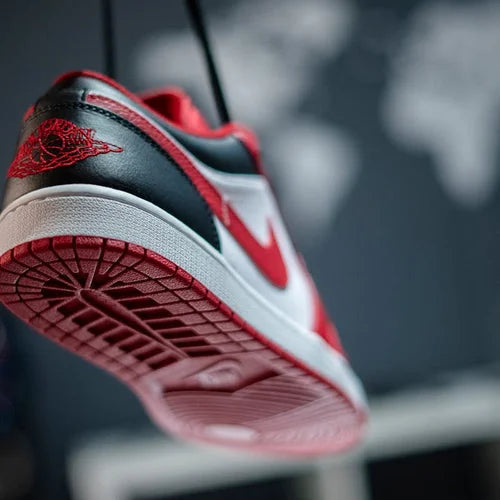
A Jordan 11 has an embroidered Jumpman on the side of the heel, as in the genuine pair above, and another on the front of the tongue. Compare the size of the logo and its position against the heel stitching, and look at the pose. On genuine pairs the fingers, the ball and the line of the legs are clean and in proportion, and the embroidery is dense with no loose threads or smudged edges.
Most Jordan 11 retros also show 23 at the heel, for Michael Jordan's jersey number. The 2018 Concord shows 45 instead, the number he wore when he returned in 1995, so 45 is not a sign of a fake on that pair. Authenticators also check the spacing of the 23 and the detail of the Jumpman's shorts, so compare both closely with a genuine pair of the same release. One of the things an authenticator compares on the 23 is the small Jumpman beside it: the gap between the head and the body and the thickness of the arms.
For Jumpman checks across every Jordan model, see our guide to the real vs fake Jordan logo.
The Patent Leather Cut

The patent leather mudguard is the part of a Jordan 11 that buyers notice first. Do not judge it by how glossy it looks, because light, the camera and age change that. Judge where it is cut and how it is finished instead: the height of the patent along the side and at the heel, the curve of its top edge and the stitching that runs along it.
The cut has changed between releases. The 2016 to 2018 retros raised the patent closer to the original 1995 shape, and the 2025 Gamma Blue has a slightly higher cut again. A patent height that differs from another release is a production change, not a fake sign. Compare it only with a genuine pair of the same release.
The Carbon Fiber Plate
Turn the shoe over and look at the midfoot. Jordan 11s have a carbon fiber shank plate there, visible through the outsole. This is the Jordan 11 check that nearly every guide uses.
On genuine pairs the plate shows a woven checkerboard with real depth. A plate that looks flat, printed or like plain plastic is a strong reason for a closer look. The genuine weave is not reliably regular or irregular, so compare the plate with one from a genuine pair of the same release rather than with a pattern rule.
The Icy Outsole
Most Jordan 11s have a translucent, or icy, outsole. Translucent rubber yellows with age as it oxidises, so yellowing is normal on older genuine pairs and proves nothing either way. A fresh, clear sole on an old release is not proof of a fake either, because storage changes how fast a sole yellows.
Look at the tread pattern and the Jumpman under the forefoot instead. The edges of the tread should be clean and the logo sharp. Two more details are among the things authenticators compare on a translucent sole: the size of the circle under the heel, which was larger on one fake Cool Grey, and how clearly the upper material shows through the rubber. For a pair where the outsole is the main check, see our Jordan 11 Cool Grey guide.
The Toe Box

Look at the toe from the front and from above. In the comparison above, the authentic toe box has a smooth, rounded patent cap and the stitch line follows the edge of the patent evenly. The fake's toe sits boxier and its stitching runs less evenly along the edge.
Check the stitching closely for loose threads, doubled stitches and lines that wander. Toe shape changes slightly between releases and with wear, so compare with a genuine pair of the same retro.
Read Next: How to Spot Fake vs. Real Jordan 9s
The Shape of the Shoe
Look at the shoe from the side and from behind. Check the angle of the heel, the height of the collar, where the toe cap ends and whether both shoes are symmetrical. Fakes often get the overall proportions slightly wrong, such as a heel that runs too straight or a toe that sits too high. From behind, many fakes look bulkier, with a wider U-shape at the heel than a genuine pair.
Compare the shape only with a genuine Jordan 11 of the same release. Other Jordan models are built on different lasts, so they are no reference for an 11.
What no longer gives a fake Jordan 11 away
One test cut a genuine Jordan 11 and three fakes in half and measured them. The leather and patent thickness were close to genuine, and so were the hardness of the outsole and midsole. The fakes fell short in places a buyer rarely looks: the ballistic nylon upper was coarser and stiffer on the genuine pair, the genuine air unit held more pressure, the genuine carbon plate was stiffer, and the fakes' foam and glue were different. So how the leather feels is no longer a reliable check, even on cheap fakes, which is why the checks above compare shape, cut and print with a genuine pair of the same release.
The Shoelaces
Genuine Jordan 11 laces are tightly woven and sit neatly through the webbing lace loops. Laces on fakes are often bulkier, looser in weave or a different length.
Laces are easy to replace, and lace details differ between releases, so treat this as a supporting check and give more weight to the parts of the shoe that cannot be swapped.
Also Read: How to Tell Real vs. Fake Jordan 6
The Size Tag Inside the Tongue
The size tag sewn inside the tongue or collar is the busiest label on a pair of Jordans. It shows the size in several systems, the country of manufacture, the style code, a UPC barcode, a short factory code and two dates. Nike has never said what the two dates mean. They are often read as the production window, but that is not confirmed, so treat them only as a rough check that they suit the release. Tags printed from around 2019 often add a QR code, and many genuine older tags have a barcode only. Counterfeiters copy genuine tags field by field, so a tag that agrees with itself shows the label is consistent, not that the shoes are real.
What a Jordan 11 tongue tag shows
On a Jordan 11 the tag sits inside the tongue. Check that the style code names the colorway you were sold, for example CT8012-104 for the 2024 Legend Blue, and that the dates are plausible for that release. Then compare the font, spacing and layout with a genuine tag from the same release, not with a tag from another model, because tag layouts change with the release and the factory.
Code checks that can expose a fake Jordan 11
No code can prove a pair is real, but these checks can expose a fake label:
- The barcode belongs to the shoe. The 14-digit number after "UPC" on the tag is Nike's barcode for one style code in one size. A fake label can carry a real Nike barcode that belongs to another colorway or size, and it still scans. An authenticator checks that the barcode is Nike's number for that style code in the size printed beside it.
- The tag and the box agree. The box label prints the same barcode with one leading zero instead of two, plus a small two-digit add-on. Ignore the zeros and the add-on, and the digits should match the tag. A mismatch is a question for the seller, not proof, because genuine pairs end up in other boxes.
- The QR code uses Nike's alphabet. The 13 characters printed beside the QR use the digits 0 to 9 and every letter except I, L, O and U. Nike's own QR server rejects any code that contains one of those four letters, and a fake tag can print them. A well-formed code proves nothing, because qr.nike.com sends every well-formed code, even an invented one, to the same Nike page and shows no result.
- The dates fit the release. On the genuine Jordan tags we have read, both dates fell before the release, the later one by two to five months. A first date after the release date is a reason to ask whether the pair is a restock, not proof of a fake. Some fakes copy genuine dates exactly, so plausible dates prove nothing either.
- The patent line is spelled right. Recent Nike tags end with "This product is covered by one or more patents: www.nike.com/patentsvirtualmarking". A misspelled line or a different address is one of the things an authenticator compares. Older tags may not carry the line at all.
You can type the style code, the barcode and the QR code into our free Nike and Jordan code checker to run the format and match checks, and our guide to what a Nike QR code and UPC can show explains each code in full.
The Box Label
The label on the end of a Jordan box repeats the shoe's details: the model name, the style code, the size, the colorway and a UPC barcode, and recent labels add a QR code. On a genuine pair in its own box, the UPC on the label matches the one on the size tag, while the box QR carries a different code from the tag QR. A second barcode sticker from a resale platform is normal, and so is a regional label on pairs sold in Asia. Box labels are the easiest part to reprint, so compare fonts and spacing only against a genuine box from the same release. A missing or replacement box is not a sign of a fake.
What to compare on a Jordan 11 box
Box designs change between Jordan 11 retros, so compare a box only with a genuine box from the same release. Check that the style code and size on the label match the size tag, and that the print is sharp and evenly aligned.
Jordan 11 Low: What Changes
The Jordan 11 Low drops the tall collar but keeps the patent leather mudguard, the icy outsole and the carbon fiber shank on most releases, so the patent cut, carbon plate, outsole and tag checks above apply to it. The heel shape, collar height and patent height are different, so compare a Low only with a genuine Low of the same release. For example, the 2025 Jordan 11 Low "Bred" is FV5104-006.
The Jordan 11 Low IE is a different design again, with less patent leather and a stitched overlay, so it is no reference for a standard Low and the other way round.
Frequently Asked Questions
How can you tell if Jordan 11s are fake?
Find the release from the style code inside the tongue, then compare the heel shape, the Jumpman and the 23, the patent cut, the carbon fiber plate, the icy outsole and the size tag and box label with a genuine pair of the same release. A bulky heel, a flat or printed plate and a barcode that belongs to another shoe are the most common giveaways.
What number is on the back of the Jordan 11?
Most Jordan 11 retros show 23, Michael Jordan's jersey number. The 2018 Concord shows 45, the number he wore on his 1995 return, so a 45 on that pair is correct.
How can you tell if Jordan 11 Lows are fake?
Use the same checks as for the High, the patent cut, the carbon fiber plate, the outsole, the Jumpman and the size tag, but compare them with a genuine Low of the same release, because the cut and the heel differ.
Do fake Jordan 11s have real carbon fiber?
Many fakes use a plate that only imitates the weave, often printed or flat. Better fakes come closer, so a convincing plate does not prove a pair is real. Compare its depth and texture with a genuine plate from the same release and confirm with the other checks.
Does the style code on the tag prove my Jordan 11s are real?
No. Every pair of a release shares the same style code, and fakes print genuine codes. The code tells you which release to compare against, and the shoes themselves decide.
Are Jumpman shoes real Jordans?
Jordan Brand sells some models under the Jumpman name, such as the Jumpman Two Trey, which borrows design elements from the Jordan 11 and 12. These are genuine Jordan Brand shoes, but they are not Air Jordan 11s. A pair sold as a Jordan 11 should carry a Jordan 11 style code on its size tag.
See If Your Jordan 11s Are Authentic
If you are still unsure after these checks, send clear photos of both shoes from the side and from behind, the Jumpman on the heel and tongue, the carbon fiber plate and outsole, the size tags and the box label. LegitGrails authenticates Jordan from photos you upload, with results in under 30 minutes and a digital certificate with every order.
If your Jordan 11s fail any of these steps, send photos to our Jordan authentication service.
Related Posts

Jordan 5 Raging Bull Real vs Fake: 2021 Retro Guide
7 minute read.
Real vs Fake Jordan 4 Military Black
8 minute read.
Jordan 11 Jubilee Real vs Fake
5 minute read.
Jordan 11 Concord Real vs Fake: How to Spot Fake Concords
10 minute read.