Union Jordan 1 Real vs Fake: Black Toe and Storm Blue

Last Updated on:
To tell a Jordan 1 Union Black Toe real vs fake, or its Storm Blue sibling, check the outer and inner Swoosh, the Air Jordan Wings logo, the heel and its stitching, the toe box, the tongue label, the hang tag and the size tag, and compare each one with a confirmed genuine pair of the same colorway.
This guide covers the two Union LA x Air Jordan 1 Retro High OG pairs from 2018, the Black Toe and the Storm Blue that many buyers call the "Blue Toe". The real and fake photos below show both. Union has released more Jordan 1s since, so check the table first to make sure these photos fit your pair.
Table of Contents
[ open ]Which Union Jordan 1 Do You Have?
Read the style code on the size tag or the box label. These are the Union Jordan 1 Highs that buyers most often ask about.
| Pair | Style code and release | Covered here? |
|---|---|---|
| Black Toe | BV1300-106, 17 November 2018, $190 at retail | Yes |
| Storm Blue ("Blue Toe") | BV1300-146, 17 November 2018, $190 at retail | Yes |
| Chicago / Shadow | HV8563-600, February 2025, $200 at retail | No. These photos do not show it, so do not apply the 2018 tells to it |
Some retailers released the Black Toe a week later, and Union restocked online on 24 November 2018. Pairs from different production runs can carry different dates on the size tag, and both are genuine.
The Outer Swoosh
Start with the outer side of the shoe. On the fake in the comparison below, the Swoosh curves more, while on the authentic pair the tail of the Swoosh ends higher up the side panel.
Check the stitching across the whole shoe as well. The fake pairs we compared show uneven stitching in several places. Look at the small UN/LA tag on the collar too: on the authentic pair its lettering is heavier.

The Inner Swoosh
Next, look at the medial side. In the comparison below, the leather on the fake pair has a heavier tumble. Leather grain varies between genuine pairs, so use it only as a supporting sign.
The more useful detail is the yellow outline. The authentic Swoosh has a distinct yellow outline, while the fake Swoosh has a skinny outline or none at all. The leather flap on the authentic pair also has a clear yellow outline, which is missing or faint on the fake.
Notice that the authentic Storm Blue at the top of the photo below looks almost tan and navy, while the fake below it looks white and blue. That is the light in the photo, not a difference between the shoes, which is why color is never a check in this guide.

The Black Toe Air Jordan Logo
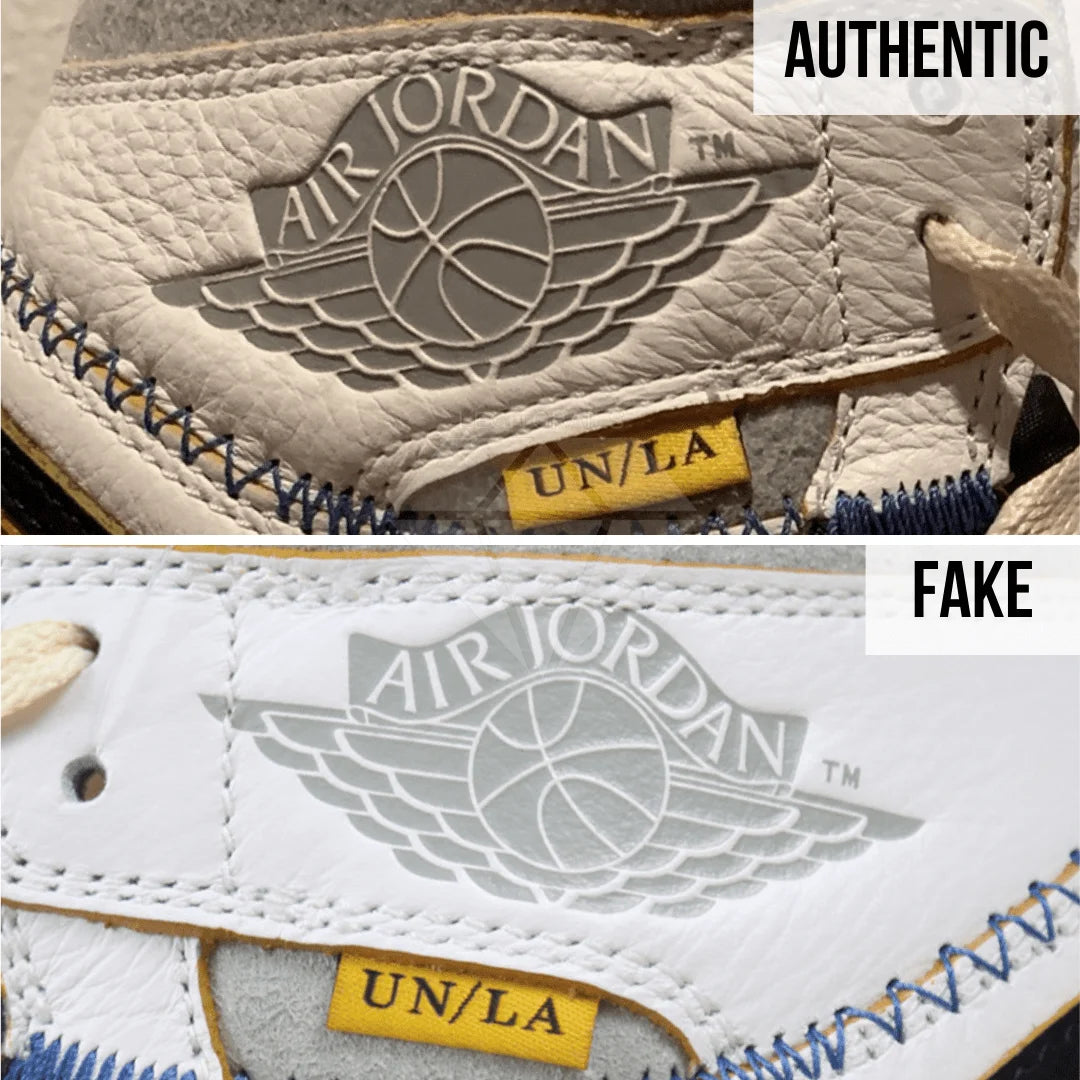
The Air Jordan Wings logo on the collar is one of the best places to compare. Look at the shape of the letters in "AIR JORDAN", the gaps between the wings, the basketball and the lettering, and where the "™" sits.
On the pair we compared, the fake's lettering is lighter than the authentic logo, and the fake's UN/LA tag below the logo is larger, with a heavier "™". Print and stamp weight change between batches, so judge these details only against a genuine Black Toe, never against another colorway.
You May Also Like: Real vs. Fake Jordan 1 Retro Bred 'Banned' 2016
The Storm Blue Air Jordan Logo
On the Storm Blue, the Wings logo is printed in black on the red collar. Here the comparison goes the other way: the authentic "AIR JORDAN" lettering and "™" are the lighter ones, and the fake's UN/LA tag is smaller.
That is why letter weight is not a rule for Union Jordans. It varies by colorway and batch, so compare with a genuine pair of the same colorway. A steadier check on this pair is the double stitching line above the UN/LA tag, which is more pronounced on the authentic pair.

The Heel Stitching and Hourglass Shape
Turn the pair around and look at the heels from behind.
First, look at the yellow outline above the double stitching. On the authentic pair in the photo, the line runs evenly and stays aligned with the stitching. On the fake it wanders and sits unevenly.
Next, look at the shape. Most retail Jordan 1 Highs narrow slightly in the middle and flare at the top and bottom, the shape often called the hourglass. In this comparison the fake is bulkier at the top and bottom. The depth of the hourglass varies by release and factory, and a worn heel loses its shape, so compare an unworn pair with a genuine Union of the same size.
Finally, the yellow zigzag stitching. Its symmetry varies between genuine pairs, so do not judge a pair by how even or uneven the zigzag looks.

The Toe Box
Look at the perforations on the toe box. On the pair we compared, the authentic holes are larger than the fake's, and they are laid out in a more even pattern. Hole size changes slightly across the size run, so compare with a genuine pair of the same size.
Read Next: Fake vs. Real Jordan 1 Shattered Backboard

The Nike Tongue Label (Black Toe)
The tongue label check works on many Jordan 1 models, as our general guide to fake Jordans shows. On the Black Toe, look at the space between the "NIKE AIR" logo and the bottom edge of the label. The authentic label in the photo leaves a clear gap, while the fake leaves less space.

If the pair has a Nike Air tongue label, one of the things an authenticator compares is the ® after NIKE AIR. On fake Jordan 1 Highs, the R often touches the circle around it or ends in small hooks, while the genuine R stands clear. Compare it only with a genuine label from the same release.
The Nike Tongue Label (Storm Blue)
The Storm Blue's tongue label has red "NIKE AIR" lettering on black. On the pair we compared, the fake's "AIR" is heavier than the authentic one. Compare the size of the black area of the label and the texture of its weave as well, always against a genuine Storm Blue label.

The Jordan Hang Tag
Both Union pairs come with a clear hang tag that shows a red square with the Jumpman and a Union signature. On the fake we compared, there is more empty space around the red square, and the Union signature is less prominent than on the authentic tag.
Hang tags are easy to buy and swap, so a correct tag proves nothing about the shoes on its own, and a missing tag is common on worn pairs. Union's Jordan 4 collaborations come with their own hang tags, which you can compare in the Jordan 4 Union Off Noir and Jordan 4 Union Guava Ice guides.

The Size Tag
The size tag sewn inside the tongue or collar is the busiest label on a pair of Jordans. It shows the size in several systems, the country of manufacture, the style code, a UPC barcode, a short factory code and two dates. Nike has never said what the two dates mean. They are often read as the production window, but that is not confirmed, so treat them only as a rough check that they suit the release. Tags printed from around 2019 often add a QR code, and many genuine older tags have a barcode only. Counterfeiters copy genuine tags field by field, so a tag that agrees with itself shows the label is consistent, not that the shoes are real.
The size tag comparison
On a Union Jordan 1 the tag should read BV1300-106 for the Black Toe or BV1300-146 for the Storm Blue, with dates plausible for a November 2018 release. The genuine Storm Blue tag in the photo has dates in May and July 2018, a few months before release, which is normal. The fake Black Toe tag next to it has dates from the same summer, which shows how well fakes copy this label.
The photo compares a genuine Storm Blue tag with a fake Black Toe tag, so treat the font comparison with care. On these two tags, the "MADE IN CHINA" and "FABRIQUE EN CHINE" lettering is heavier on the authentic tag, and the "F" and "E" are shaped differently. Use that only against a genuine tag from the same colorway. The spacing of the UPC digits changes with the tag printer, so it is not a check either. What does help is that the UPC on the tag matches the one on the box label.

Code checks that can expose a fake Union Jordan 1
No code can prove a pair is real, but these checks can expose a fake label:
- The barcode belongs to BV1300-106 or BV1300-146. The 14-digit number after "UPC" on the tag is Nike's barcode for one style code in one size. A fake label can carry a real Nike barcode that belongs to another colorway or size, and it still scans. An authenticator checks that the barcode is Nike's number for BV1300-106 or BV1300-146 in the size printed beside it.
- The tag and the box agree. The box label prints the same barcode with one leading zero instead of two, plus a small two-digit add-on. Ignore the zeros and the add-on, and the digits should match the tag. A mismatch is a question for the seller, not proof, because genuine pairs end up in other boxes.
- The QR code uses Nike's alphabet. The 13 characters printed beside the QR use the digits 0 to 9 and every letter except I, L, O and U. Nike's own QR server rejects any code that contains one of those four letters, and a fake tag can print them. A well-formed code proves nothing, because qr.nike.com sends every well-formed code, even an invented one, to the same Nike page and shows no result.
- The dates fit the release. On the genuine Jordan tags we have read, both dates fell before the release, the later one by two to five months. A first date after the November 2018 release is a reason to ask whether the pair is a restock, not proof of a fake. Some fakes copy genuine dates exactly, so plausible dates prove nothing either.
- The patent line is spelled right. Recent Nike tags end with "This product is covered by one or more patents: www.nike.com/patentsvirtualmarking". A misspelled line or a different address is one of the things an authenticator compares. Older tags may not carry the line at all.
You can type the style code, the barcode and the QR code into our free Nike and Jordan code checker to run the format and match checks, and our guide to what a Nike QR code and UPC can show explains each code in full.
Made in China: Is That a Fake Sign?
Jordans are made by Nike's contract factories, mainly in Vietnam, Indonesia and China. Nike's 2025 annual report puts those three countries at about 51, 28 and 17 percent of its footwear. One colorway can come from more than one country, and Nike's own product pages list some Air Jordan models as made in China in one size range and Indonesia or Vietnam in another. So "Made in Vietnam" or "Made in China" proves nothing alone. What matters is that the country, the factory code and the tag layout fit each other and the release, which only a genuine pair from the same release can show.
The Box Label
The label on the end of a Jordan box repeats the shoe's details: the model name, the style code, the size, the colorway and a UPC barcode, and recent labels add a QR code. On a genuine pair in its own box, the UPC on the label matches the one on the size tag, while the box QR carries a different code from the tag QR. A second barcode sticker from a resale platform is normal, and so is a regional label on pairs sold in Asia. Box labels are the easiest part to reprint, so compare fonts and spacing only against a genuine box from the same release. A missing or replacement box is not a sign of a fake.
The Black Toe colorway is White/Varsity Red-Wolf Grey-Black under BV1300-106, so expect that style code and colorway on its box label.
Frequently Asked Questions
Is the "Blue Toe" the same as the Storm Blue?
Yes. "Blue Toe" is the nickname buyers use for the Union x Air Jordan 1 Storm Blue, style code BV1300-146, released alongside the Black Toe in November 2018.
What are the Union Jordan 1 style codes?
The 2018 Black Toe is BV1300-106 and the Storm Blue is BV1300-146. The 2025 Chicago / Shadow is HV8563-600.
Do the 2025 Union Chicago / Shadow pairs use the same tells?
Not all of them. The 2025 pair has its own materials and color blocking, and the photos in this guide show only the 2018 pairs. Read its style code first and compare it with a genuine HV8563-600.
My tag dates differ from a friend's pair. Is one fake?
Not necessarily. Union sold the pairs at launch and in a restock, and pairs from different production runs can carry different dates. Dates should be plausible for a 2018 release, but fakes copy them too, so they settle nothing alone.
Does the hang tag prove my pair is real?
No. A hang tag can be bought separately or copied. It is one detail to compare, and the shoes themselves decide.
Does the weight of the shoe tell real from fake?
No. On one fake Black Toe, the weight differed from a genuine pair by only 14 g, which is negligible. Weight also changes with size.
Get Your Union Jordan 1 Checked
If you are still unsure after these checks, send clear photos of both sides of each shoe, the Wings logo with the UN/LA tag, the heels from behind, the toe box, the tongue label, the hang tag if you have it, the size tags and the box label. LegitGrails authenticates Jordan from photos you upload, with results in under 30 minutes and a digital certificate with every order.
If your Union Jordan 1 fails any of these steps, send photos to our Jordan authentication service.
Related Posts

Jordan 11 Jubilee Real vs Fake
5 minute read.

Jordan 11 Concord Real vs Fake: How to Spot Fake Concords
10 minute read.


